



The Intihuatana stone of Machu Picchu, known as the “place where the sun is tied,” is not just a carved stone. It is a sacred symbol connected to the sun, the mountains, Inca rituals, and the observation of the sky. Although for many years it was understood as a solar clock, its true meaning seems to be far deeper and more mysterious.
In this blog, you will discover what Intihuatanas are, where they can be found, what purposes they may have served, and why the Intihuatana of Machu Picchu remains one of Peru’s greatest mysteries today.
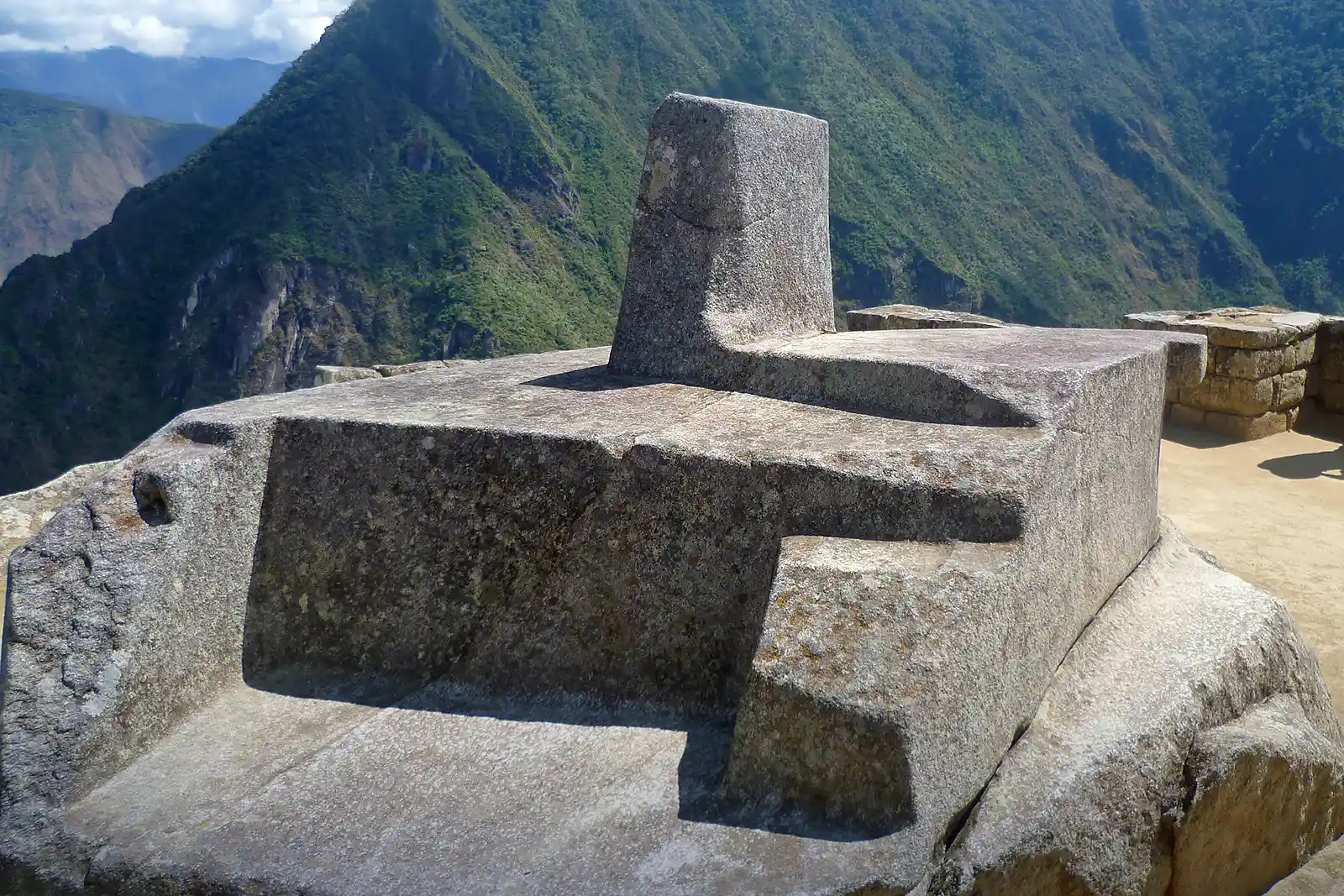
What is the Intihuatana?
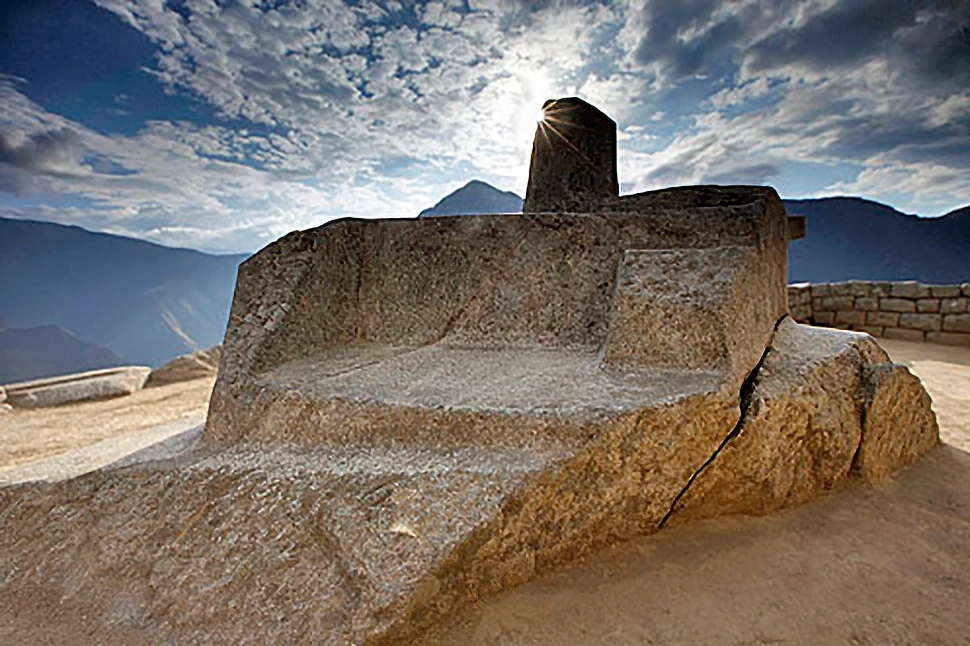
The Intihuatana is a ceremonial stone carved from a single rock. Among its most remarkable features are its finely carved steps and a central pillar, details that reflect its sacred character and its possible connection to solar and celestial observation ceremonies.
What does Intihuatana mean?
Intihuatana means “place where the sun is tied” or “place to which the sun is bound.” It comes from the Quechua words inti (“sun”) and wata (“to tie” or “year”), so it can also be understood as the “place where the solar year is measured.”
The Intihuatana Stone of Machu Picchu
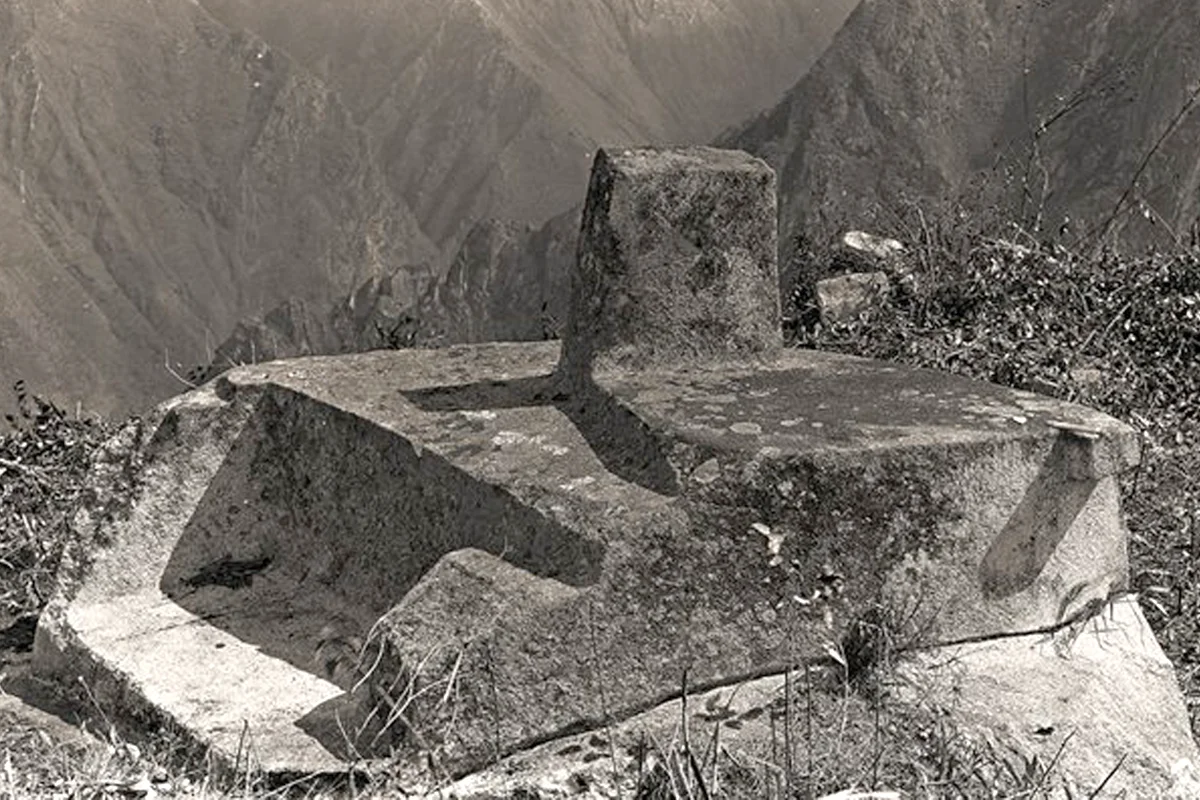
At the beginning of the last century, explorer Hiram Bingham identified an intihuatana at Machu Picchu, located on the top of a hill surrounded by terraces. He gave it this name because he connected it with other intihuatanas he had seen in the Sacred Valley during his time in Cusco.
His first impression was that this carved stone worked as a sundial, an interpretation shaped by his Western perspective. However, the meaning of the Intihuatana goes far beyond that.
Where is the Intihuatana of Machu Picchu located?
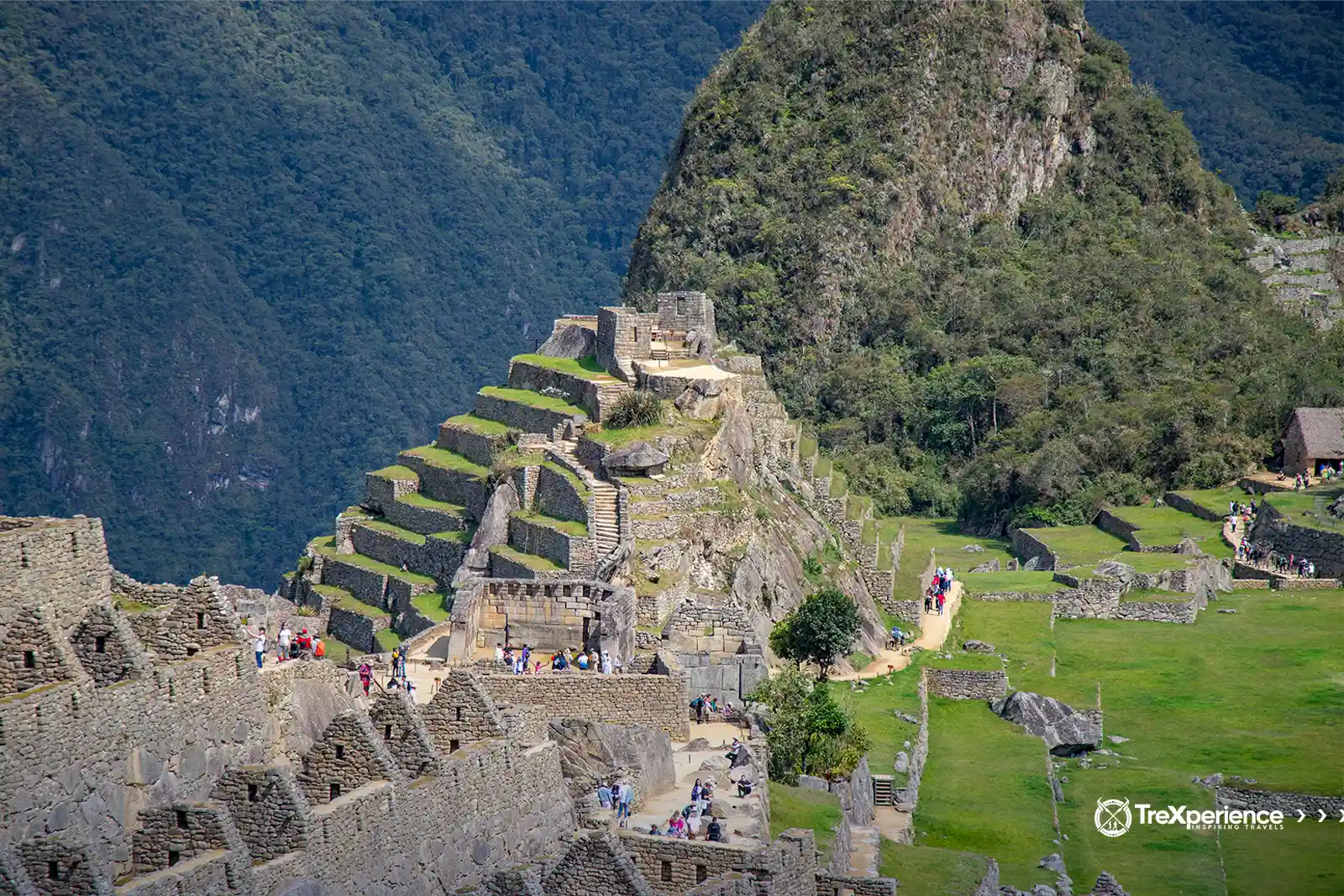
The Intihuatana sits on top of a rocky outcrop, reached by climbing 78 stone steps, within the area known as the “sacred space” next to the temple plaza in the citadel of Machu Picchu.
It stands out because it is located higher than the surrounding structures. It is easy to recognize, as the hill rises above the landscape and is surrounded by ceremonial enclosures and terraces. Because of its unique shape, it is also known as the Pyramid of the Intihuatana.
Details of the Intihuatana of Machu Picchu
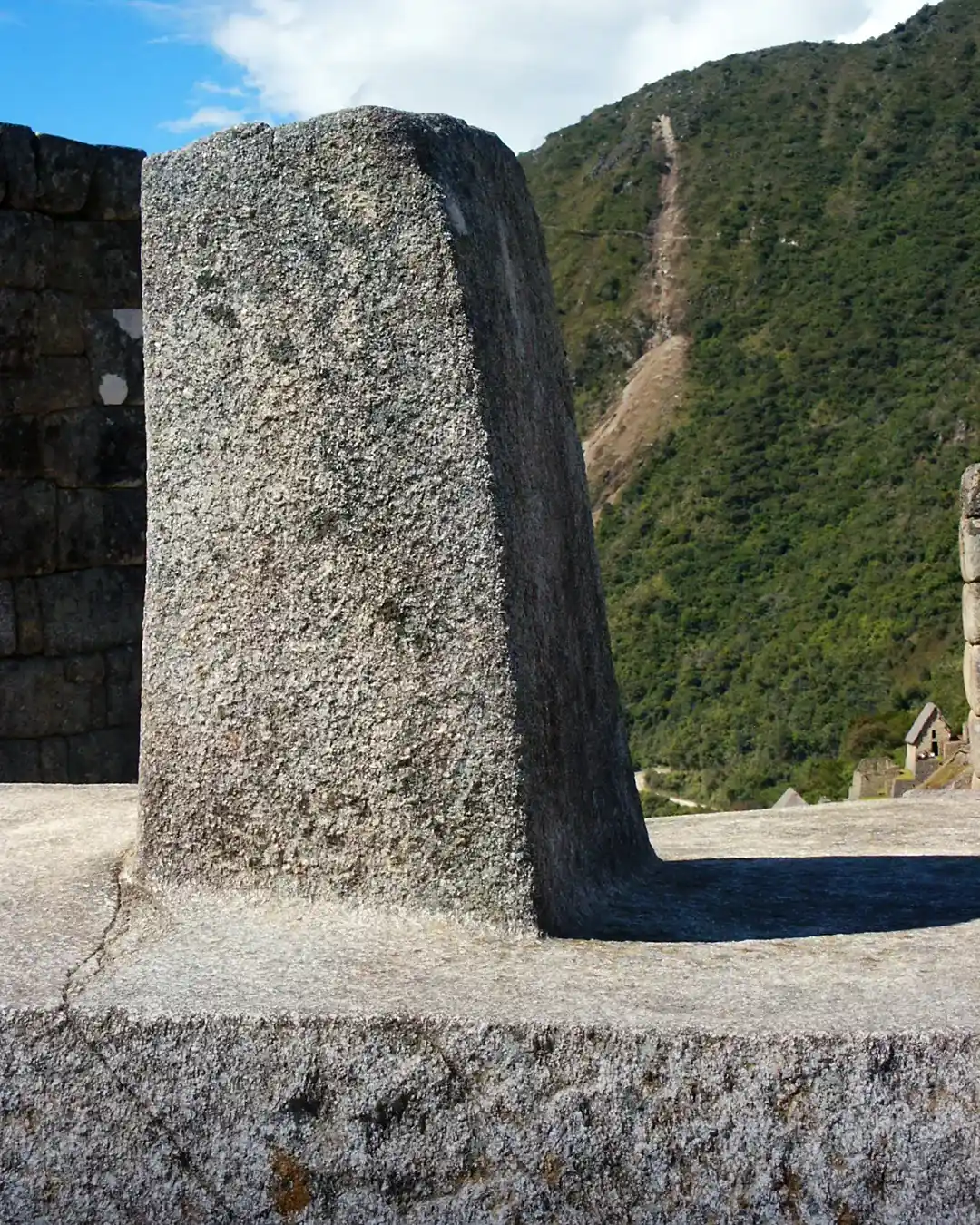
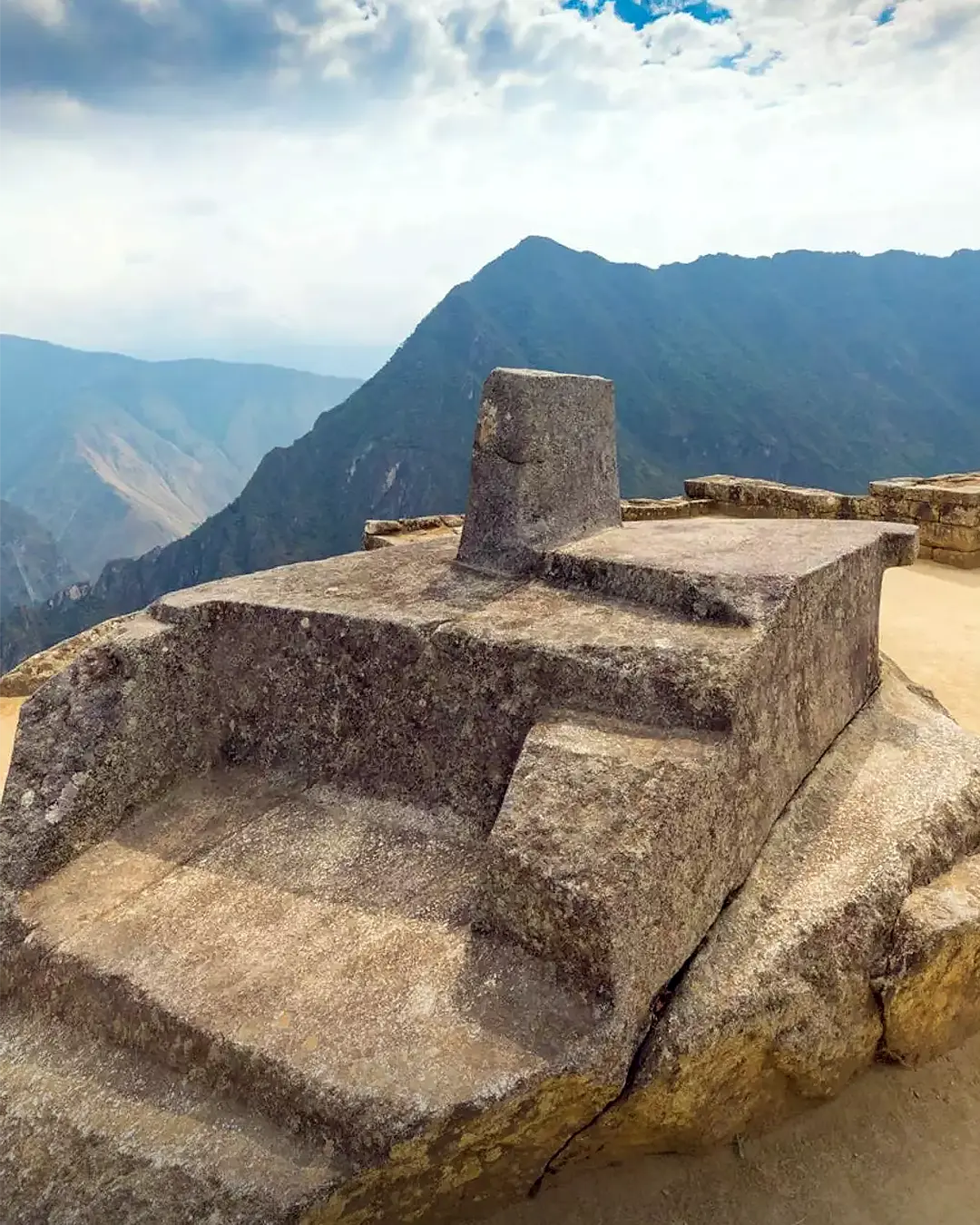
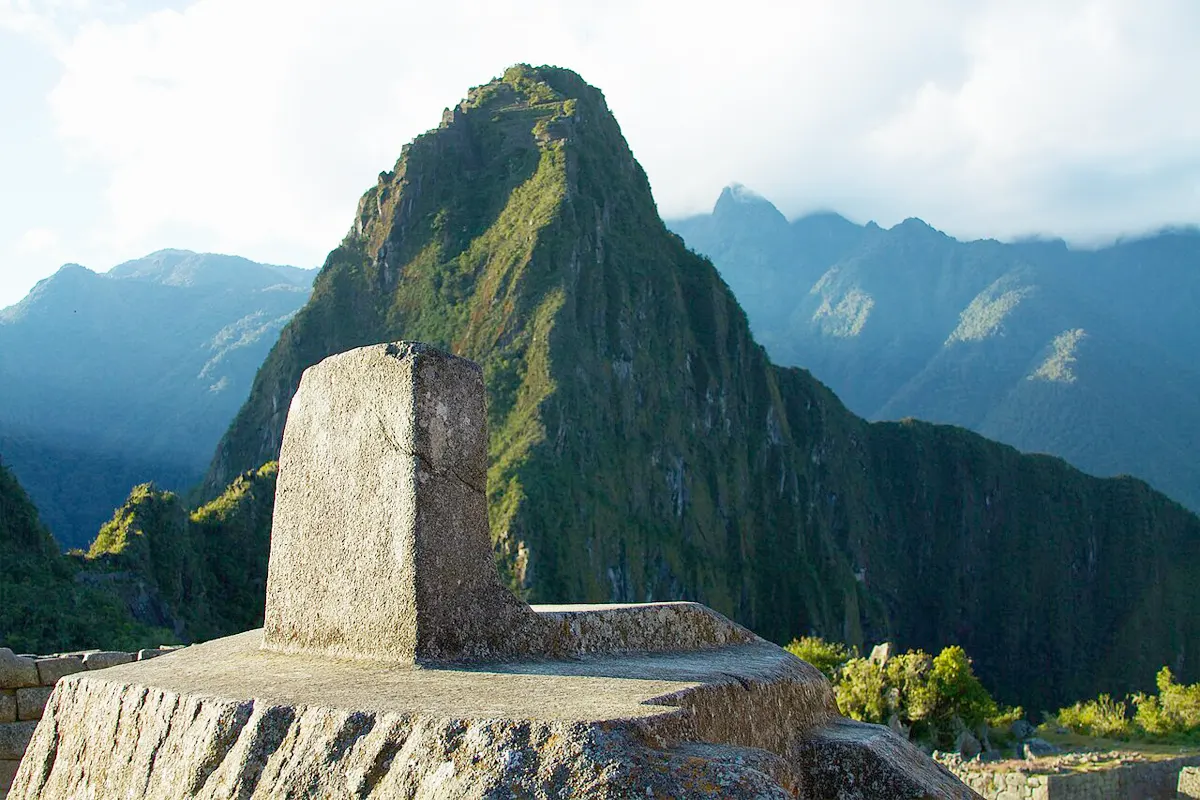
The Intihuatana is carved from a single piece of granite rock, meaning it was sculpted directly in the place where it still stands today. It has an approximate perimeter of 8.60 meters and a height of about 1.70 meters. At the top, a small projection stands out, similar to an obelisk, measuring around 0.36 meters high and shaped like an almost cubic polyhedron.
This monolith resembles a small pyramid with straight angles, several levels or platforms, and a seat-shaped base facing south. At the top, it has a rectangular surface and a small raised section, all carefully polished and finely worked.
One curious detail is that this small projection has an inclination of about 13 degrees, making the Intihuatana even more fascinating.
 |  |
Interesting fact: In 2000, during the filming of a commercial, a crane hit one of the corners of the Intihuatana, causing irreversible damage.
Sacred alignment of the Intihuatana of Machu Picchu
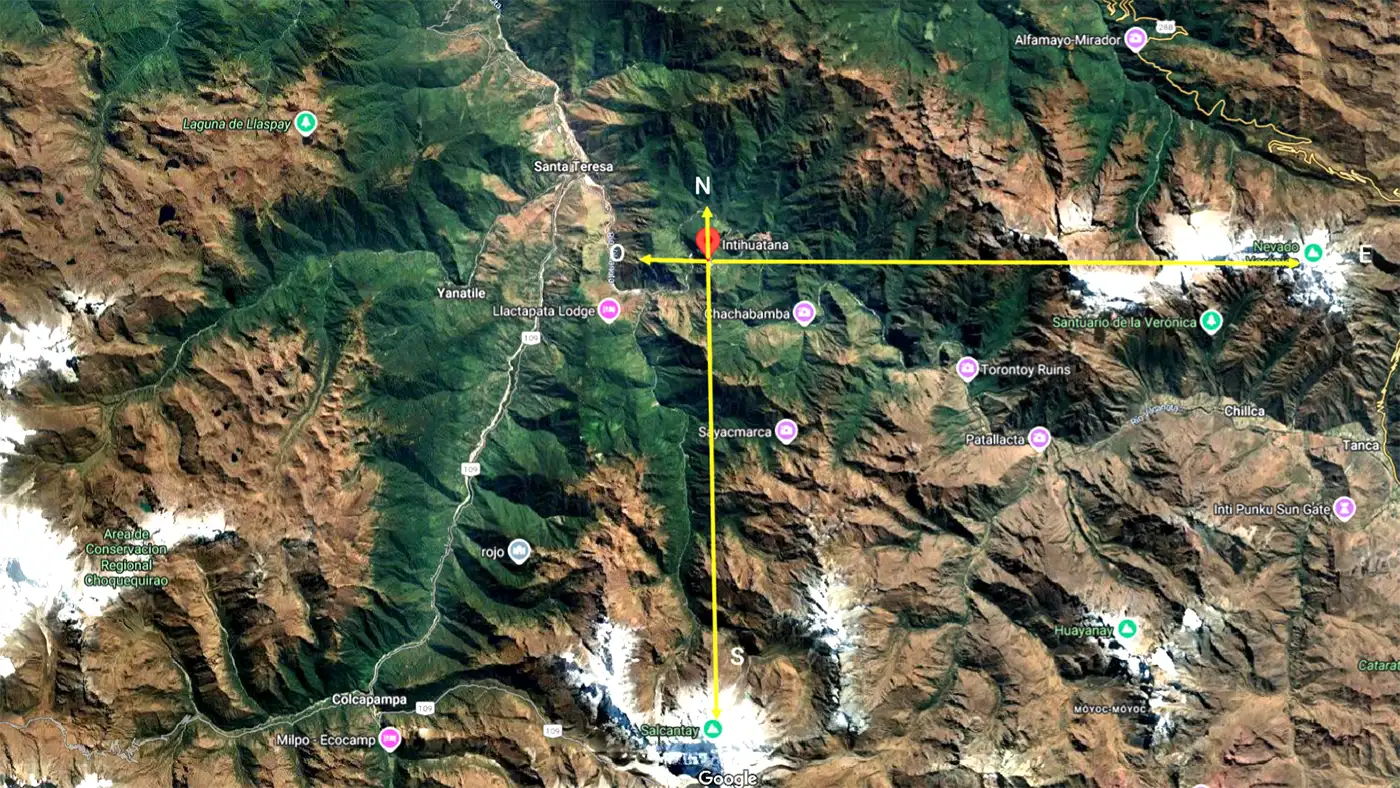
Beyond the theories, one thing that is hard to deny is the remarkable alignment of the Intihuatana with the cardinal points and certain angles associated with magnetic north. This suggests that Inca specialists had advanced knowledge of orientation and astronomical observation.
For example, the geographical location of the Intihuatana is aligned with the following sacred mountains, or Apus:
- To the south, with the imposing Salkantay.
- To the east, with the snow-capped Verónica Mountain, or Wakay Willka “sacred tears”, where the sun rises during the equinoxes.
- To the north, with Huayna Picchu.
- To the west, with the Pumasillo mountain range, where the sun sets during the summer solstice.
Can you visit the Intihuatana of Machu Picchu?
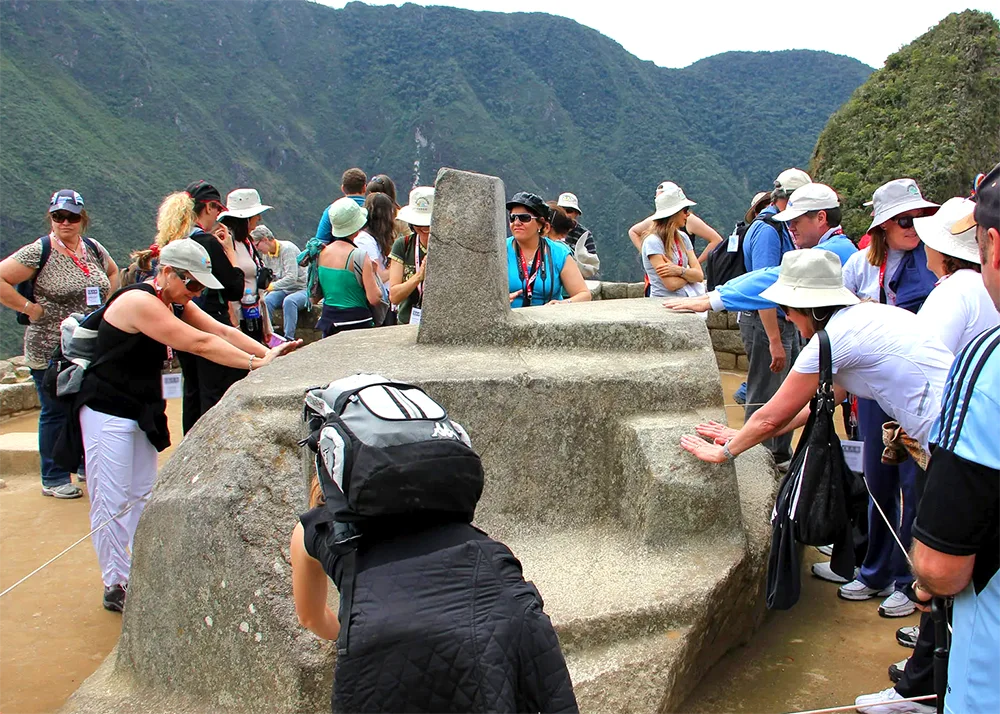
No, it is no longer possible to visit the Intihuatana of Machu Picchu directly since 2023. Access remains restricted indefinitely due to stone deterioration found on its stairways and access points, caused by the constant flow of visitors.
Before this restriction, visitors could reach the Intihuatana through Circuit 2 of Machu Picchu. They would climb up to the site, see the monolith up close, and even place their hands a few centimeters from the stone to “feel the energy” that, according to popular tradition, was believed to be concentrated there.
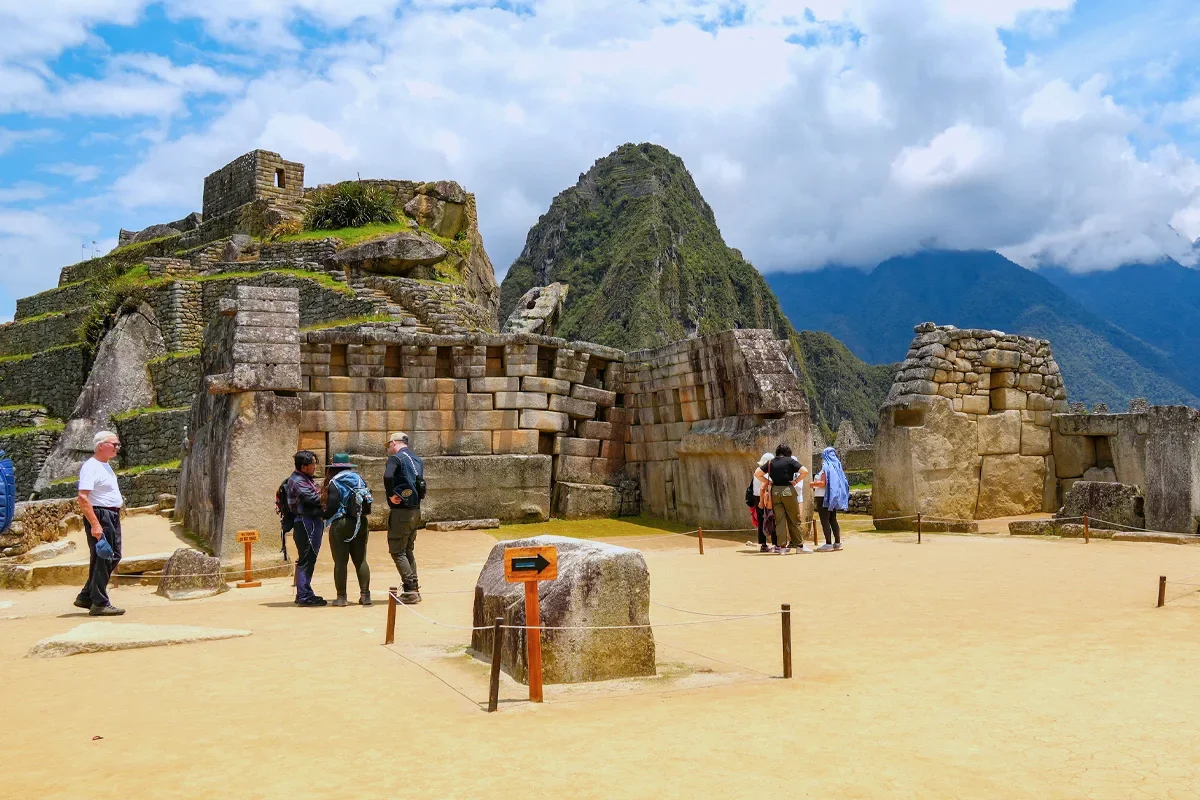
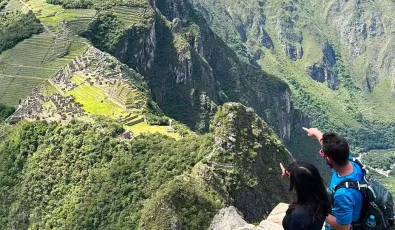
Today, you can still see the Intihuatana from a distance through Circuit 2 during your visit to Machu Picchu, specifically along Routes 2A and 2B. You can also view the Intihuatana from above from the summit of Huchuy Picchu Mountain, which is accessed through Circuit 3, Route 3D.
What was the purpose of the Intihuatanas?
There are several theories about the purpose of the Intihuatana. Among the most important are:
Astronomical observatory
The function most often linked to the intihuatanas suggests that they served as astronomical observatories. The Intihuatana was used to measure time between the solstices and equinoxes. These dates were important because they were connected to major Inca ceremonies, such as:
- Winter solstice - June: The Festival of the Sun, or Inti Raymi, one of the most important celebrations in honor of the god Inti, the Sun.
- September equinox: Coya Raymi, linked to the Moon, fertility, and the celebration before the agricultural season.
- Summer solstice - December: Qhapaq Raymi, related to the crop-growing season and the rains.
- March equinox: a time of harvest and gratitude for the food received.
At the Intihuatana of Machu Picchu, it is believed that, besides observing the path of the sun, specialists may also have carried out night-sky observations, including stars and constellations such as the Pleiades, the Southern Cross, Spica, Alpha Centauri, Vega, Deneb, and Altair.
Ritual altar and sacred shrine
Another possible purpose of the Intihuatana was to serve as a ceremonial stone or altar, where offerings were made to Inca gods, celestial beings, and sacred mountains.
In the case of the Intihuatana at Machu Picchu, its flat, finely polished, almost glass-like surface stands out, suggesting that Inca ceremonies may have taken place there. Another fascinating detail is the way the shadows cast on the rock seem to match the profile of Waynapicchu Mountain.
Sundial
The idea that the intihuatanas worked as sundials is one of the least likely interpretations and one of the least supported by researchers. This is partly due to the typical climate of the high jungle and the Andes, where cloudy and clear skies often alternate throughout the day, making it difficult to observe the sun with precision.
At the Intihuatana of Machu Picchu, this interpretation becomes even more complex because mist and light rain are common in the area.
In addition, it is believed that the Incas did not need this type of tool to orient themselves during the day. Most likely, observing the position of the sun was enough to know the time of day, a practice still preserved by many Andean communities.
The Myth of the Intihuatana and the Gentiles
There is an Andean myth preserved in Chuquinga, Apurímac, called Gentilkunamanta Rimay, or “Speaking of the Gentiles,” a story compiled by Rubén Aucahuasi. It is also related to the tale of Inkarri, which comes from the Áncash region and was made known by Alejandro Ortiz.
Both stories speak of the supernatural abilities of mythical beings who lived before the conquest of the Incas. These beings had superhuman powers and could “tie the sun” to the earth, extending its time in the sky.
This titanic act was meant to prolong daylight and ensure the sun’s benefits for crops and livestock. In this way, people could have more time to work the land and produce more food, an essential reserve for facing difficult times, conflicts, and natural events that constantly affected ancient Peruvians.
The Intihuatanas and the Apus
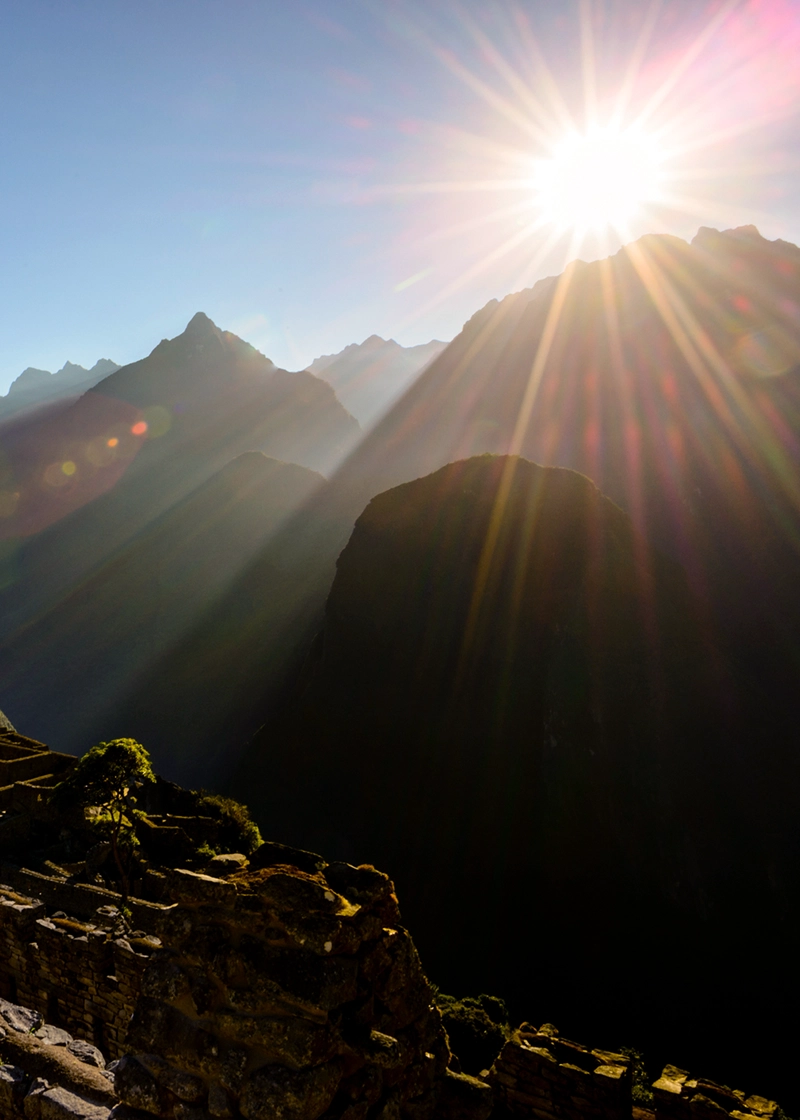
More recent studies connect the intihuatanas with a deeper spiritual and ceremonial purpose. According to archaeologist Federico Kauffman Doig and other researchers, the Intihuatana was also linked to the Apus, the sacred mountains, and was used for rituals meant to prevent feared famines and climate-related disasters.
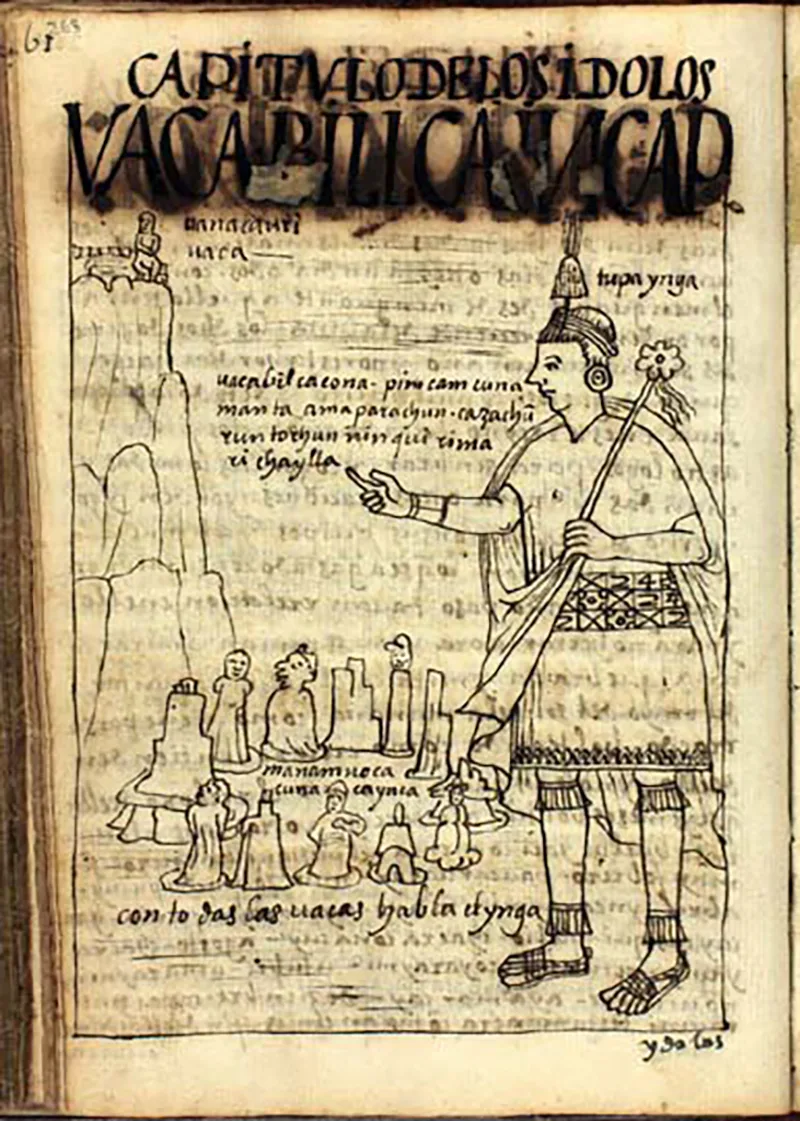 |  |
Kauffman Doig bases this idea on the drawings of the chronicler Guamán Poma de Ayala, in which he depicts mountains alongside figures called idol-Intihuatana, very similar to the Intihuatana of Machu Picchu. This suggests that the Intihuatana may have been a symbolic representation of the sacred mountains.
For the Incas, mountains were sacred, powerful, and worthy of respect and gratitude. These protective beings were also represented in figures or idols. For that reason, both the sacred mountains and the intihuatanas shared the same purpose: to serve as places of worship and ceremonial altars.
Huayna Picchu Mountain and the Intihuatana of Machu Picchu
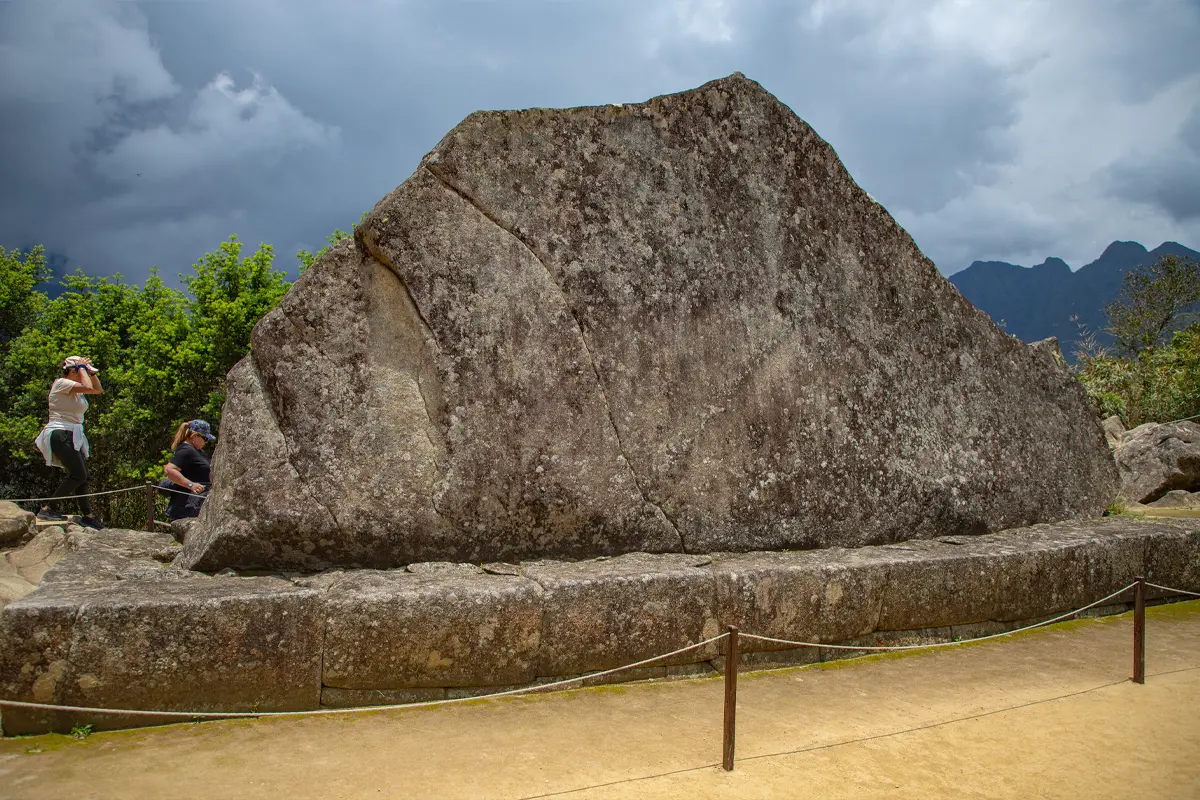
At different archaeological sites across Peru, there are stones that symbolize important sacred mountains for each region. This is the case with the so-called Sacred Rock at Machu Picchu, a large stone that reproduces or reflects the profile of Apu Yanantin, the sacred mountain located to the northeast.
In the case of the Intihuatana, it is believed that it may represent Huayna Picchu Mountain, since the shadows of the small central monolith seem to match the shadows and profile of this mountain throughout the day. In this sense, the Intihuatana would have served as a huaca, or sacred representation of the mountain itself.
Other Intihuatanas in Cusco
There are other structures identified as intihuatanas in the Cusco region, such as those in Pisac and Ollantaytambo. However, there are also different constructions known as saywas and sukankas, which may have served similar purposes: observing celestial bodies and worshiping the sun.
Some researchers believe these may have been the original names for this type of sacred structure, since the term intihuatana only began to spread in 1877 thanks to archaeologist Ephraim George Squier.
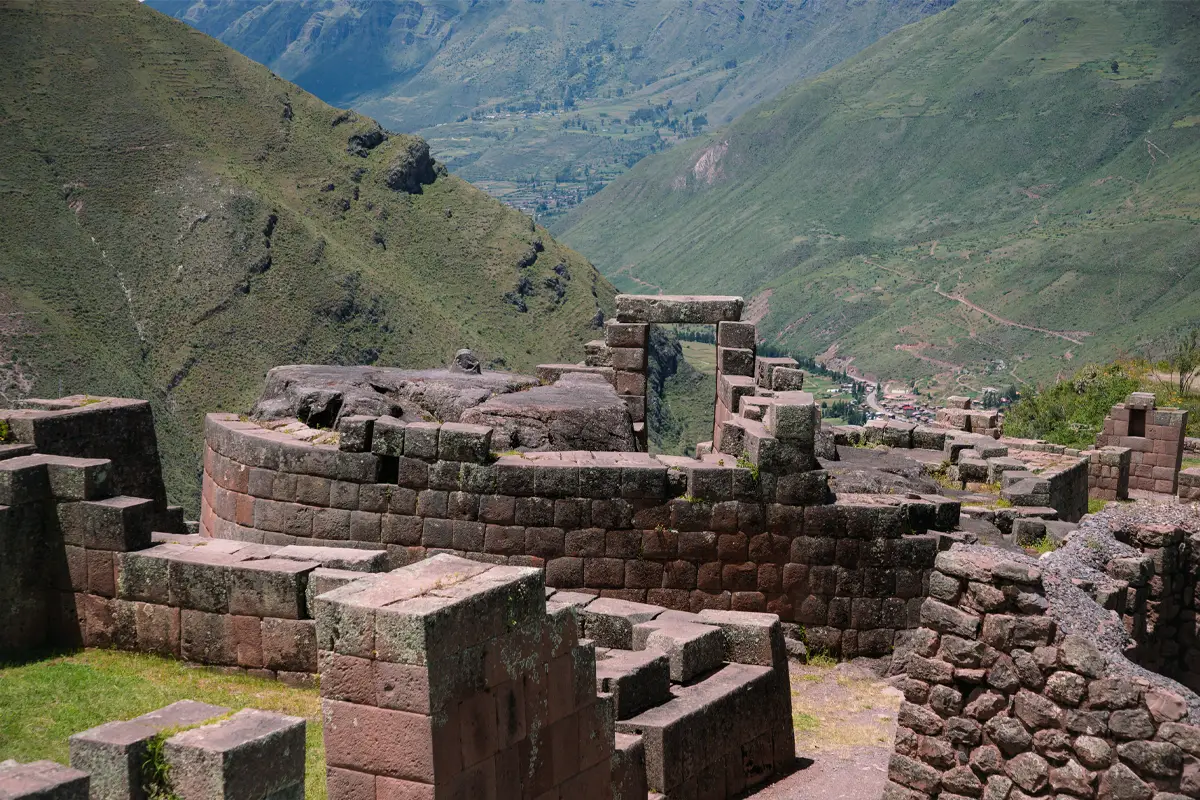
Today, only the Intihuatana of Pisac, in the Sacred Valley, can be visited. Access to the Intihuatana of Ollantaytambo, on the other hand, remains restricted because it is located in an area that is difficult to reach.
The Unknown Intihuatana of Machu Picchu
If you thought there was only one Intihuatana, you are mistaken. There is a second Intihuatana, almost unknown even to locals, hidden among the nearby forests.
This mysterious Intihuatana is located between the confluence of the Aobamba River and the Urubamba River, at km 122 of the train route that connects Aguas Calientes with Hidroeléctrica, inside private property and surrounded by dense vegetation.
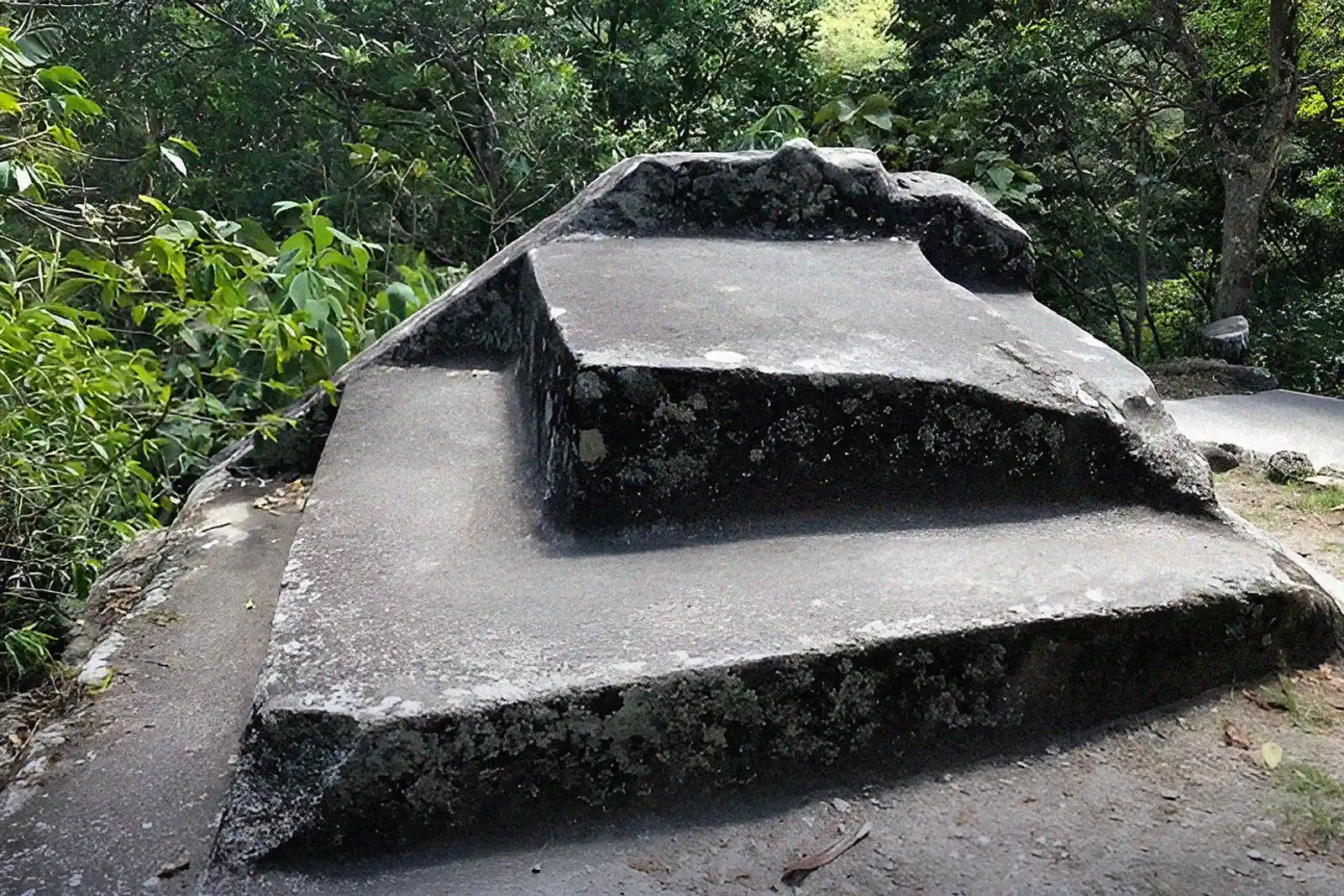
It is a granite monolith carved from a single piece, with a stepped structure similar to the famous Intihuatana of Machu Picchu, although without its characteristic projection. It measures approximately 3 meters wide by 1.5 meters high. Around it, there are a couple of structures and small wells, suggesting that the site may have had a ceremonial use.
But what makes it even more intriguing is its funerary context. Evidence of ancient burials has been found nearby, strengthening the theory that this space may have been a sacred site, possibly used for rituals related to death and transcendence.
This enormous stone is located on the sunrise axis of the June solstice. Spatially, during this special date, it aligns with the Temple of the Sun at Llactapata and the sacred plaza of Machu Picchu.
Today, there is little official information about the site, but its features strongly suggest that it was built by the Incas. It remains a mystery that leaves many questions open.
How to get there?
To visit this enigmatic site, you need to walk approximately three hours from Aguas Calientes along the railway toward Hidroeléctrica. The entrance is only a few meters from the train station, and a sign marks the access point.
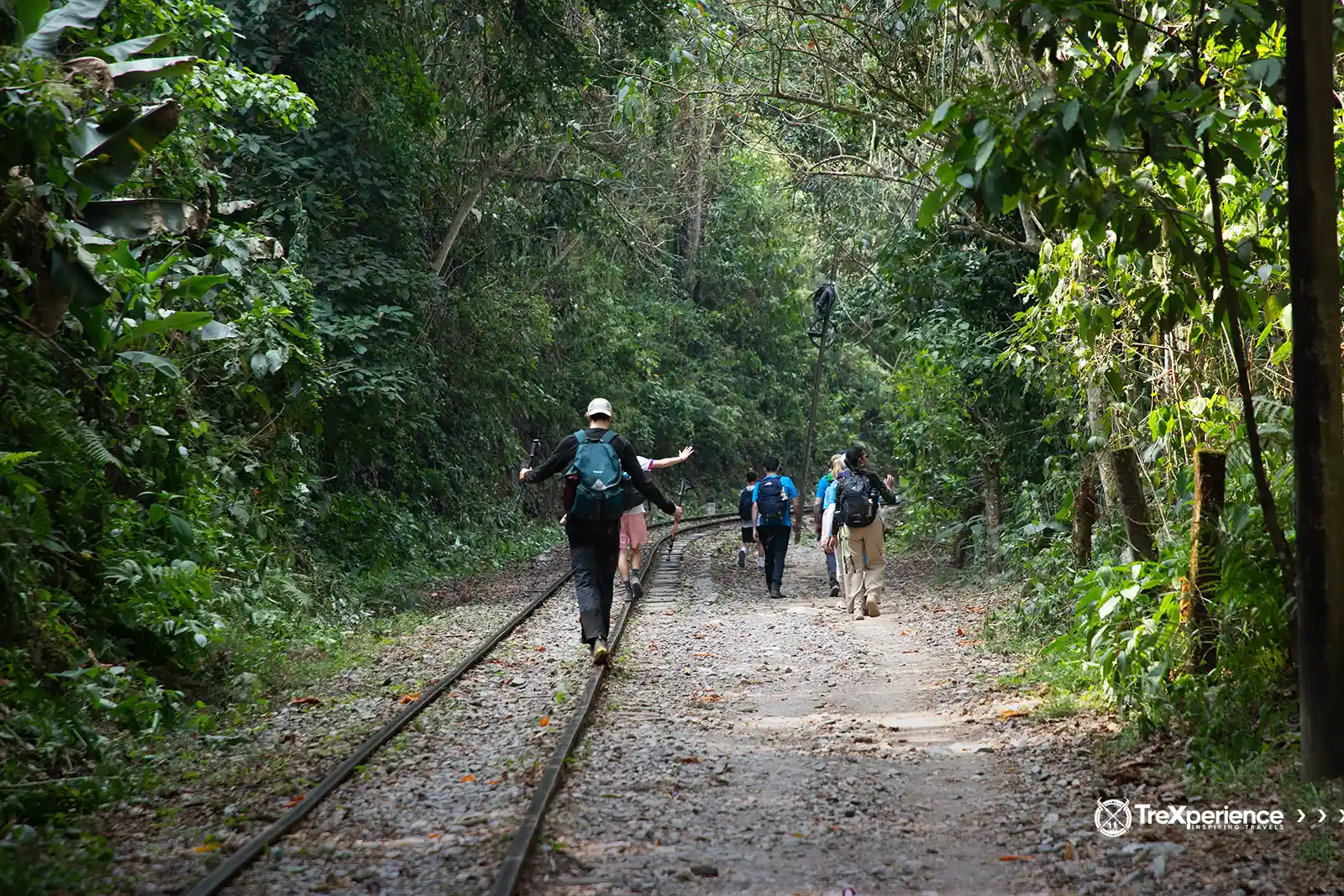
Important: If you decide to explore this place, remember that it is located on private property, so it is essential to respect the area and its owners.
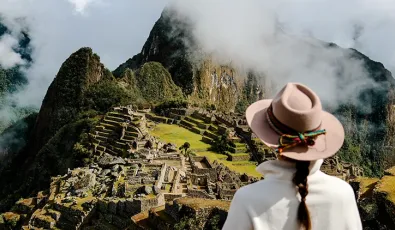
The Intihuatana reminds us that Machu Picchu was not just a city built among mountains, but a sacred space where architecture, astronomy, and Andean spirituality came together in an extraordinary way.
Although today it is not possible to get close to this masterpiece, you can still explore its surroundings and admire it from a distance as part of the sacred landscape of Machu Picchu. If you would like to understand these details more deeply, we can accompany you on a guided visit to discover together the meanings that often go unnoticed along the way.
Intihuatana Stone of Machu Picchu FAQs
Was the Intihuatana related to the Inca calendar?
Possibly. Because of its location, shape, and connection with the movement of the sun, it may have helped mark important dates in the Inca ritual and agricultural calendar.
Was the Intihuatana used only by Inca priests?
It is not known for certain, but because of its sacred location and ceremonial character, it was probably used by religious specialists, astronomers, or authorities connected to important rituals.
Where is the best place to see the Intihuatana today?
One of the best-known places to see it is the area near the temple plaza, within the authorized route. It can also be viewed from a higher angle when hiking Huchuy Picchu Mountain on Route 3D.
Is the Intihuatana related to the energy of Machu Picchu?
Many people associate it with the spiritual energy of Machu Picchu. However, this idea is more closely linked to popular tradition and the symbolic experience of the place than to a proven scientific explanation.
What makes the Intihuatana of Machu Picchu different from other sacred stones?
Its location, carved shape, alignments, and connection with the sacred landscape make it special. It is not just a worked stone, but a piece deeply integrated with the mountains, the sky, and the ceremonial architecture of Machu Picchu.

Add new comment