



Have you ever heard of a Peruvian bird so striking that it looks hand-painted? The Andean cock-of-the-rock, also known as the tunqui, is one of the most admired species among travelers, photographers, and nature lovers.
In this blog, you’ll learn what makes it so special, how to tell the male and female apart, where it lives, and where in Peru you might be able to see it in the wild.
What is the Andean cock-of-the-rock?
The Andean cock-of-the-rock is an Andean-Amazonian bird known for the male’s rounded crest and intense plumage. It is also known as the tunqui and is considered one of Peru’s most representative natural symbols.
Its appearance, courtship behavior, and close connection to the forests of the high jungle make it one of the most eye-catching birds in South America.
Scientific name and common names
The scientific name of the andean cock-of-the-rock is Rupicola peruvianus. It belongs to the Cotingidae family, a group of tropical birds in which several species stand out for their colors, calls, and courtship displays.
It is also known as the Andean cock-of-the-rock, Peruvian cock-of-the-rock, or tunqui. This last name comes from the Quechua language and is still used in several Andean and Amazonian areas. In English, it is known as the Andean cock-of-the-rock.
Its scientific name is also connected to its habitat. The word Rupicola comes from Latin and means “rock dweller,” while peruvianus refers to Peru.
Why is it called the cock-of-the-rock?
It is called the cock-of-the-rock for two main reasons:
- The first is related to the male’s appearance, as its rounded crest, posture, and bright color symbolically resemble a small rooster.
- The second reason is connected to its closeness to rocky areas, where it often moves around and builds its nests.
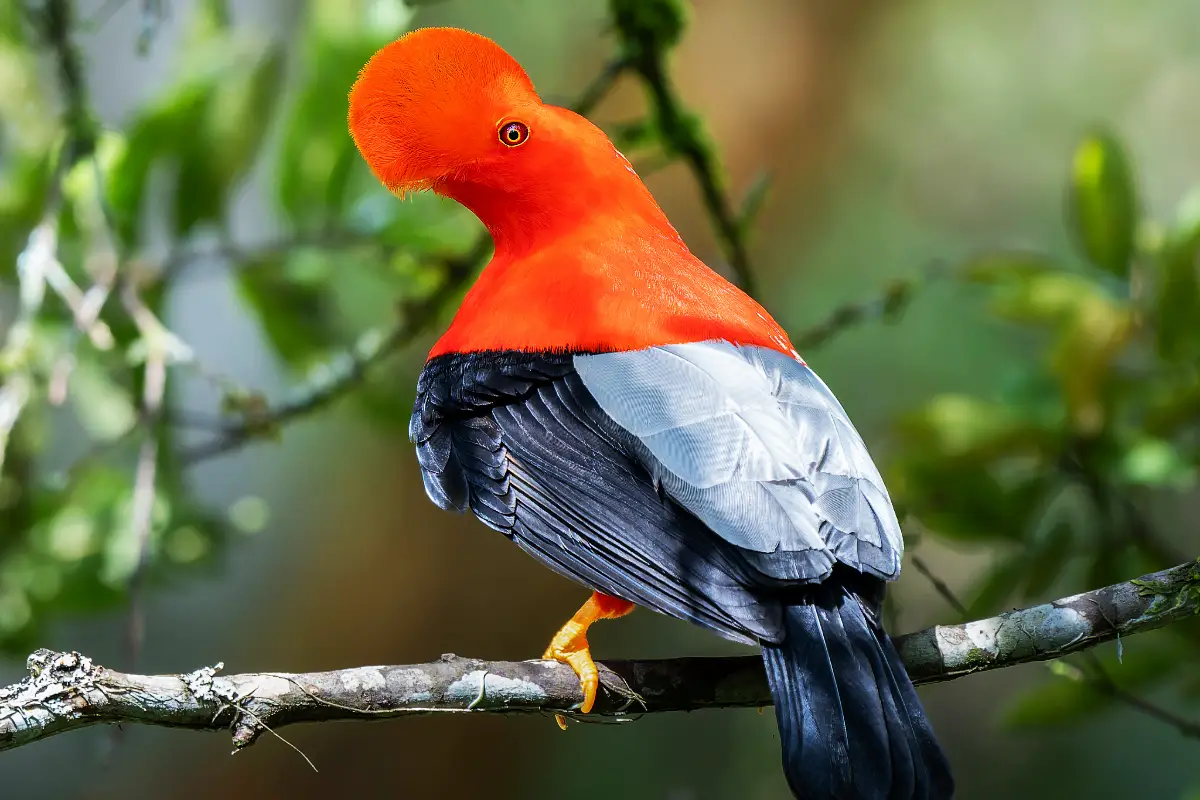
Quick facts about the Andean cock-of-the-rock
| Fact | Information |
| Common name | Andean cock-of-the-rock |
| Other name | Tunqui |
| Scientific name | Rupicola peruvianus |
| Family | Cotingidae |
| Type of bird | Passerine bird |
| Country where it is the national bird | Perú |
| Declared national bird | December 11, 1941 |
| Main habitat | Cloud forests, high jungle, ravines, and rocky areas |
| Distribution | Tropical Andes of South America, from Venezuela to Bolivia |
| Diet | Mainly fruits; it may also eat insects and small animals |
| Most striking feature | Bright red or orange plumage in the male |
| Main difference | The male is colorful; the female is brown and more discreet |
| Notable behavior | Group courtship displays by males in areas known as leks |
| Ecological importance | Helps disperse seeds and supports forest regeneration |
Why is the Andean cock-of-the-rock Peru’s national bird?
It is Peru’s national bird because of its beauty, uniqueness, and strong connection to Andean-Amazonian forests. It was declared the national bird of Peru on December 11, 1941, through Supreme Resolution No. 983, and since then it has been considered one of the most representative symbols of Peruvian wildlife.
Its selection is due to its presence in ecosystems that are very important for the country, such as cloud forests and the high jungle. For this reason, the Andean cock-of-the-rock represents both Peru’s natural wealth and the need to protect its forests. Its importance is also linked to the ecosystems it represents.
Characteristics of the Andean cock-of-the-rock
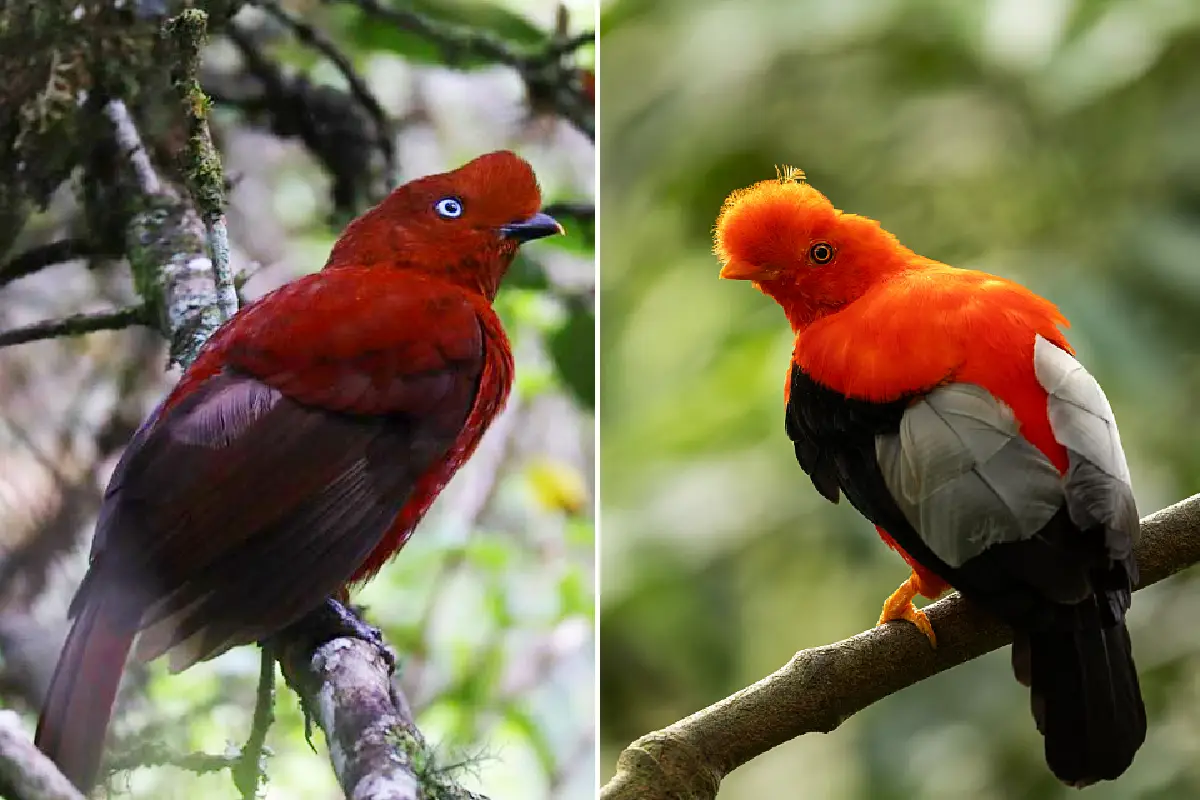
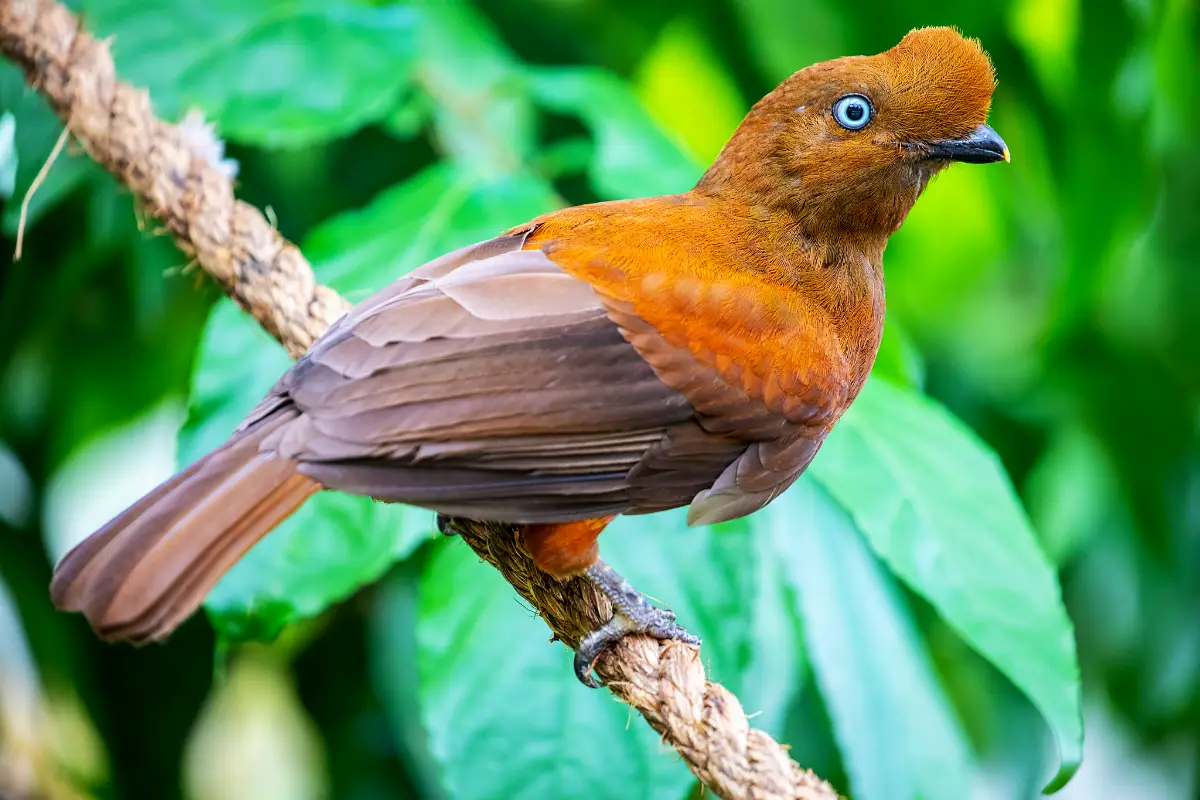
The Andean cock-of-the-rock has an unmistakable appearance. The male stands out for its reddish-orange plumage, dark wings, and large rounded crest that covers part of its beak. The female, on the other hand, has brown and reddish tones that are much more discreet.
This difference between male and female is known as sexual dimorphism. In males, the bright colors help during courtship; in females, the duller tones provide camouflage, especially during nesting.
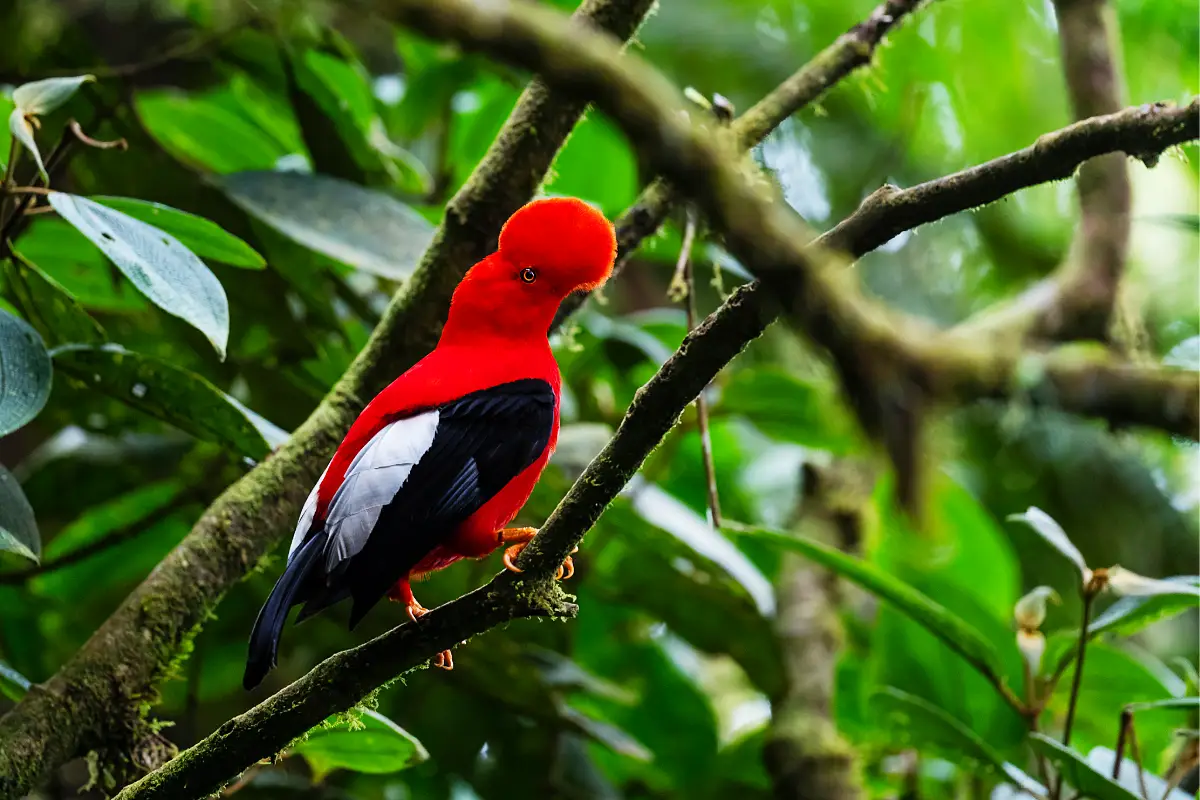
Differences between the male and female Andean cock-of-the-rock
The male and female have very visible differences, especially in color, crest, and behavior during reproduction.
| Difference | Male | Female |
| Color | Bright orange or reddish-orange | Reddish-brown or chestnut |
| Crest | Large, rounded, and very visible | Smaller and more discreet |
| Appearance | Very striking | More subtle and camouflaged |
| Behavior | Dances and calls to attract a mate | Builds the nest and cares for the chicks |
| Visibility | Easier to recognize because of its color | Harder to spot among the vegetation |
| Reproductive role | Takes part in leks or group displays | Incubates and feeds the chicks |
Where does the Andean cock-of-the-rock live?
The Andean cock-of-the-rock mainly lives in cloud forests, high jungle, and humid mountain areas. It prefers places with dense vegetation, ravines, streams, cliffs, and rocky walls, where it finds shelter and suitable nesting sites.
In South America, it is found along the tropical Andes, from Venezuela to Bolivia. In Peru, it can be found in Andean-Amazonian regions such as Cusco, Madre de Dios, San Martín, Pasco, Huánuco, and other areas with well-preserved forests.
High jungle and humid areas
In addition to cloud forests, the Andean cock-of-the-rock also lives in high jungle areas, where the climate is warm and humid for much of the year. The high jungle usually extends from around 400 to 1,500 meters above sea level. These environments provide food, shelter, and the right conditions for this bird to thrive.
Cloud forests, its main home
Andean cloud forests are one of its main habitats. They are generally found between 1,500 and 3,000 meters above sea level. These environments often have frequent mist, constant humidity, moss-covered trees, and abundant vegetation—ideal conditions for this species to find shelter and food.
Rocky ravines where it nests
One of this cock of the rock species’ favorite places is ravines and rocky walls near rivers or humid areas. There, females build their nests using mud, roots, and plant remains. These vertical surfaces offer greater protection from predators and harsh weather conditions. In fact, this close relationship with rocky outcrops is the reason it received the name cock-of-the-rock.
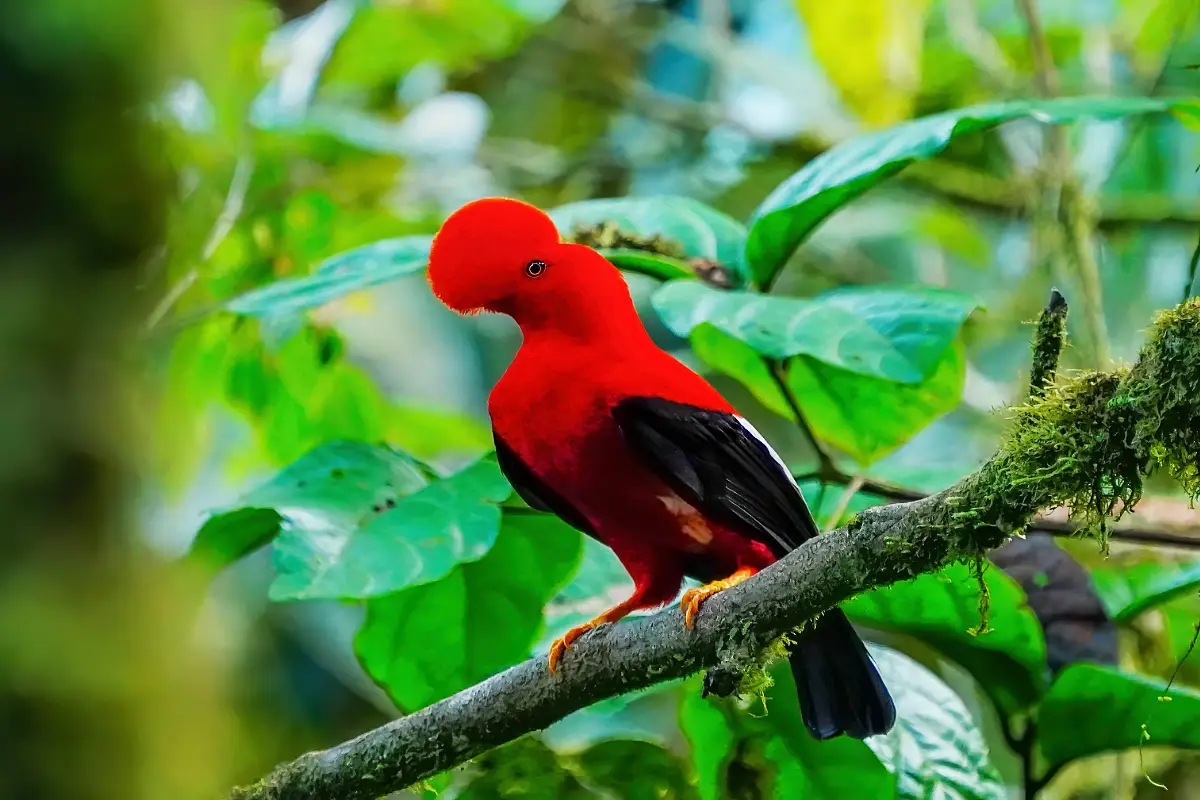
Diet of the Andean cock-of-the-rock
The Andean cock-of-the-rock feeds mainly on wild fruits, which is why it is considered a frugivorous bird. Its diet makes it important for the forest because, by eating fruits, it can disperse seeds and help new plants grow.
- It eats small fruits, berries, and fleshy fruits from trees and shrubs.
- It may also feed on insects, especially during the breeding season.
- Chicks need more protein, so adults may bring them insects and small invertebrates.
- Its diet depends greatly on humid, well-preserved forests.
Reproduction and courtship ritual
The reproduction of the Andean cock-of-the-rock is one of the most fascinating parts of its behavior. The male mainly takes part in courtship, while the female builds the nest, incubates the eggs, and cares for the chicks.
During the breeding season, several males gather in specific areas of the forest to display in front of females. There, they compete through movements, sounds, and plumage displays.
What is a lek or courtship area?
A lek is an area of the forest where several males gather to perform their courtship displays. In the case of the Andean cock-of-the-rock, these places are usually near ravines, cliffs, streams, waterfalls, or rocky areas with dense vegetation.
In a lek, males do not build nests or care for chicks. Their main role is to gather in one place so females can watch them and choose a mate. The female visits these areas, observes the males’ behavior, and then chooses which one to mate with.
The famous dance of the Andean cock-of-the-rock
The famous dance of the Andean cock-of-the-rock is a courtship display in which several males try to catch the attention of females. To do this, they jump between branches, lower their heads, open their wings, show off their crest, and make loud calls.
The male’s bright color plays an important role during this display. Its red or orange plumage, together with its movements and sounds, helps it stand out within the group. The female watches these displays and chooses the male she considers most suitable for reproduction.
Nests in rocky areas
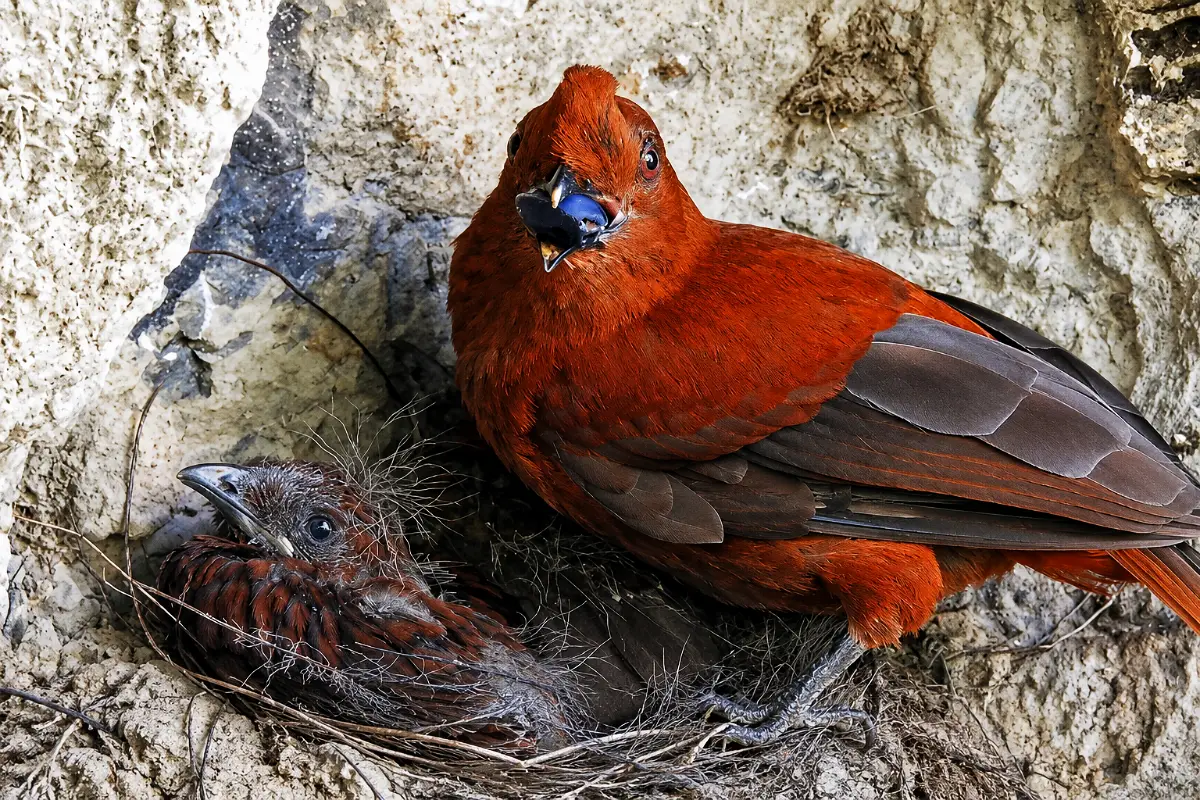
After mating, the female looks for protected places to build her nest. She usually builds it on rocky walls, in cavities, or in areas near watercourses, where there is greater protection from some predators.
The nest is usually attached to rocky surfaces and has a cup-like shape. It is made with mud, plant fibers, and other materials from the surrounding area. The female does this work alone and is also responsible for incubating the eggs and feeding the chicks during their first stages of life.
Places in Peru to see the Andean cock-of-the-rock
| Place | Region / Approximate altitude | Why it stands out |
| Manu Cloud Forest | Cusco / Madre de Dios - 500 to 2,500 m | It is one of the best places to see Andean cock-of-the-rocks in the wild. |
| Cock of the Rock Lodge | Cusco - 1,400 to 1,700 m | It stands out for its courtship areas, where males gather to call and display. |
| Machu Picchu Historic Sanctuary | Cusco - 1,800 to 2,600 m | It protects humid forests where this bird can be seen, especially in less-traveled areas. |
| Yanachaga Chemillén National Park | Pasco - 300 to 3,600 m | It protects montane forests and high jungle areas, important habitats for the species. |
| Tingo María National Park | Huánuco - 600 to 1,800 m | It is a warm and humid area with ravines and forests that are ideal for this bird. |
| Alto Mayo Protection Forest | San Martín - 800 to 2,800 m | It is known for its great biodiversity and as an important birdwatching destination. |
| Abra Patricia | Amazonas - 1,800 to 2,500 m | It is one of the most valued routes for birdwatchers in northern Peru. |
| Río Abiseo National Park | San Martín - 350 to 4,200 m | It protects extensive cloud forests where this emblematic species lives. |
Places to see the Andean cock-of-the-rock in Cusco
Cusco is one of the best places in Peru to observe this emblematic bird, especially in areas of humid forest, high jungle, and protected natural areas. Cusco has humid forest and high jungle zones where this bird can live, especially in areas near Manu, Machu Picchu, and some sections of the Inca Trail.
On the Inca Trail
On the Inca Trail, it can be found in cloud forest areas, especially in humid sections with dense vegetation. It is not always easy to spot, as it often moves among trees and ravines, but its presence is part of the great biodiversity that accompanies this route to Machu Picchu.
In Machu Picchu
The Machu Picchu Historic Sanctuary protects humid forests where the Andean cock-of-the-rock lives. It may appear in less-traveled areas, near streams, and in places with abundant vegetation. Although it is not one of the easiest birds to see along the main tourist route, its presence is part of the biodiversity protected by the Machu Picchu Historic Sanctuary.
In Manu
Manu is one of the best areas in Cusco to see the Andean cock-of-the-rock in the wild. In its forests, there are courtship areas where males gather to call, jump, and show off their plumage. For this reason, it is often recommended for travelers interested in birdwatching.
If the habitat of the Andean cock-of-the-rock sparked your curiosity about nature, a Tambopata tour can bring you closer to the biodiversity of the Amazon, with tropical forests, rivers, colorful birds, and wildlife. It’s an ideal way to complement your visit to Cusco and discover another side of the Peruvian jungle.
Is the Andean cock-of-the-rock endangered?
The Peruvian cock-of-the-rock is not classified as globally endangered, but its conservation depends on the health of the forests where it lives. Deforestation, habitat loss, and disturbance in its courtship areas can affect its populations in specific places.
Protecting cloud forests, avoiding illegal capture, and promoting responsible birdwatching are important actions to help conserve this species in the wild.
Fun facts about the Andean cock-of-the-rock
- The Andean cock-of-the-rock usually chooses specific areas of the forest where the light, vegetation, and space allow it to perform its famous courtship dance more effectively.
- Although this bird is famous for its appearance, there are still aspects of its wild life that are not fully understood. For a long time, people talked more about its color and dance than about details such as its nests, chicks, or exact behavior in less-studied areas.
- The chicks of this bird are born very dependent. During their first weeks, they need constant protection, as it takes them several days to regulate their body temperature properly and remain safe inside the nest.
- Its nests also have a curious story. After being abandoned, they can continue to be useful within the forest, as other birds may reuse them as shelter or nesting spaces.
- Although it is Peru’s national bird, many people only know it from pictures and have never seen it in the wild.
Tips for observing and photographing the Andean cock-of-the-rock in Peru
Seeing the Andean cock-of-the-rock in its natural habitat can be an unforgettable experience, but it requires patience and respect for the environment. These recommendations will help increase your chances of spotting it without affecting its behavior.
- Visit cloud forests early in the morning, when bird activity is usually higher.
- Keep quiet and avoid sudden movements so you do not scare the birds away.
- Wear neutral-colored clothing that blends in with the natural surroundings.
- Avoid using flash, as it can disturb the birds’ natural behavior.
- Stay on authorized trails and respect the rules of protected areas.
- Do not play recorded bird calls to attract birds, especially during the breeding season.
- Be patient; sometimes you may need to wait several minutes or even hours for a good sighting.
- Hiring a local guide specialized in birdwatching can greatly increase your chances of finding it.
- Use a camera with a good zoom or telephoto lens so you do not need to get too close.
- Keep your distance from courtship areas and never approach nests.
- Avoid speaking loudly or staying too long in one spot if you notice the bird becoming disturbed.
Frequently asked questions about the Andean cock-of-the-rock
Can the Andean cock-of-the-rock be kept as a pet?
No. The Andean cock-of-the-rock is a wild bird and should live freely in its natural habitat. Keeping it as a pet is neither recommended nor responsible, as it needs cloud forests, natural food, and suitable spaces to survive.
Why does the Andean cock-of-the-rock have such bright colors?
The male’s bright color plays a role during courtship, as it helps attract the attention of females.
Does the Andean cock-of-the-rock sing?
Yes, but its sounds are not soft or melodic. During courtship, the male makes loud calls to stand out among other males.
Is the Andean cock-of-the-rock an aggressive bird?
Not toward people. However, males can compete with each other during courtship, using sounds, movements, and displays to stand out from other males.
What is the best time of day to see it?
The early morning hours are usually the most recommended, because birds are more active and there is less noise in the surroundings.

Add new comment