



The Caral civilization offers a glimpse into a very early period of Peru’s history, long before the development of other major Andean societies. Its age, monumental buildings, and the discoveries made in the Supe Valley have raised many questions about who its inhabitants were and how they managed to organize such a complex society.
Learning about the Caral also helps explain why this site holds such an important place in the history of the Americas and which aspects of this ancient civilization are still being studied today.
Quick Facts About the Caral Civilization
| Fact | Information |
| Age | Approximately 5,000 years old |
| Period | 3000 - 1800 BC |
| Location | Supe Valley, Barranca, Lima |
| Cultural area | North-central coast of Peru |
| Main center | Sacred City of Caral |
| Archaeological period | Late Archaic Period of the Central Andes |
| Outstanding feature | Monumental architecture and carefully planned urban centers |
| World Heritage status | Sacred City of Caral-Supe, a UNESCO World Heritage Site since 2009 |
| Historical recognition | Considered the oldest known civilization in the Americas |
What Was the Caral Civilization?
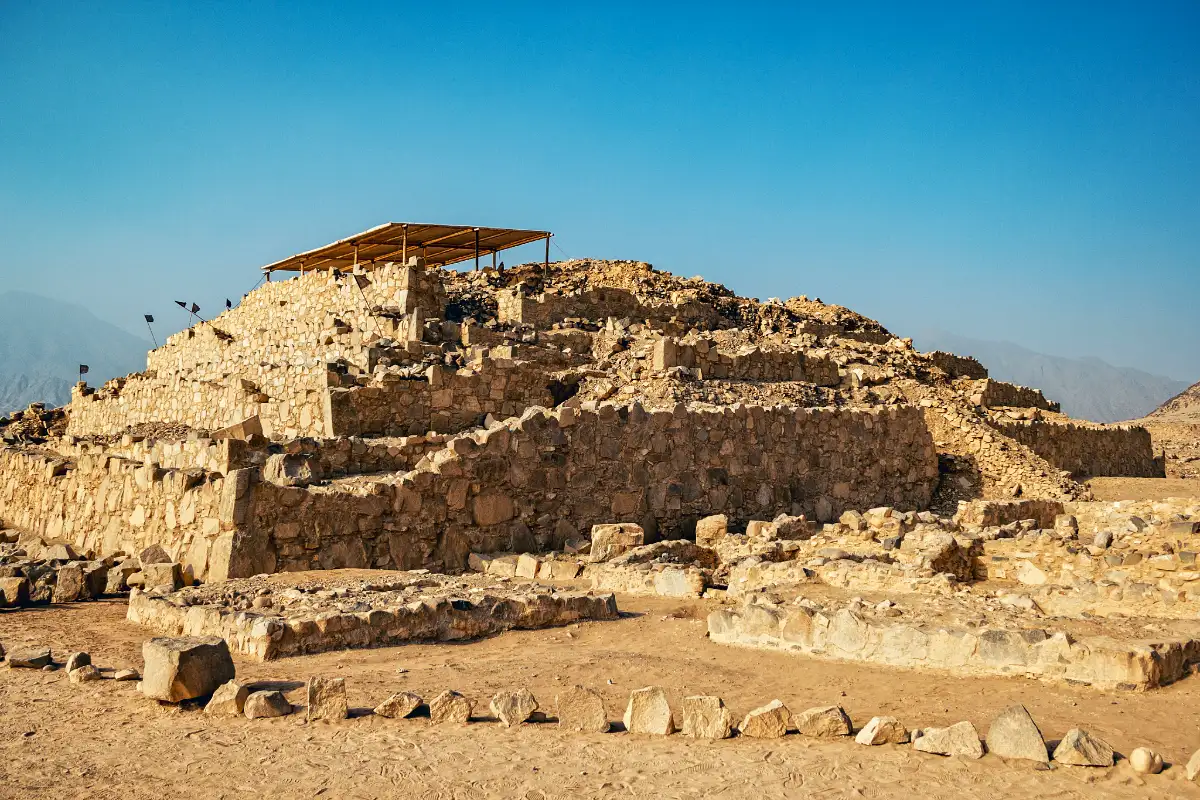
The Caral civilization was one of the earliest complex civilizations in the Americas. It developed around 5,000 years ago in the north-central region of Peru, with a significant concentration of settlements in the Supe Valley. Caral was not limited to the archaeological city that carries its name today. It was part of a wider network of settlements with different sizes and functions.
This society was capable of organizing collective labor, constructing large public buildings, planning urban spaces, and developing a hierarchical social and political structure. These features help explain Caral’s importance in the origins of Andean civilization.
Where Did the Caral Civilization Develop?
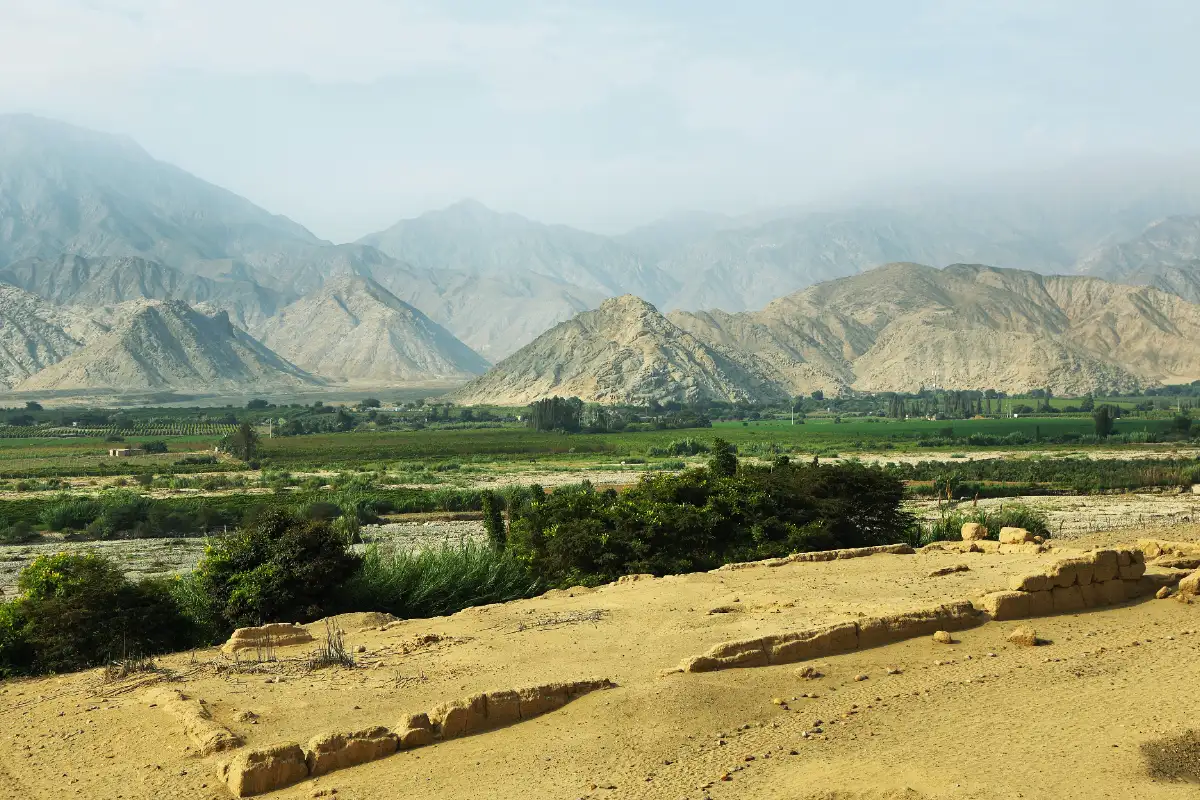
The Caral civilization developed in the north-central region of Peru, mainly in the Supe Valley, in what is now Barranca Province in the Lima Region. Numerous settlements were established on both sides of the Supe River, including the Sacred City of Caral.
The valley offered suitable land for agriculture and was located close to the coast, making it easier to obtain resources from both inland areas and the Pacific shoreline. This strategic position also encouraged contact with other regions of the Andes.
Who Discovered Caral and How Did Its Research Begin?
Caral was already known to researchers before Ruth Shady began her work. However, it was Shady who started systematic research in the Supe Valley in 1994 and began excavations at the Sacred City of Caral two years later.
Her studies revealed the site’s remarkable age and complexity. This led researchers to recognize Caral as part of a civilization that developed approximately 5,000 years ago and played a fundamental role in understanding the origins of Andean civilization.
Caral History
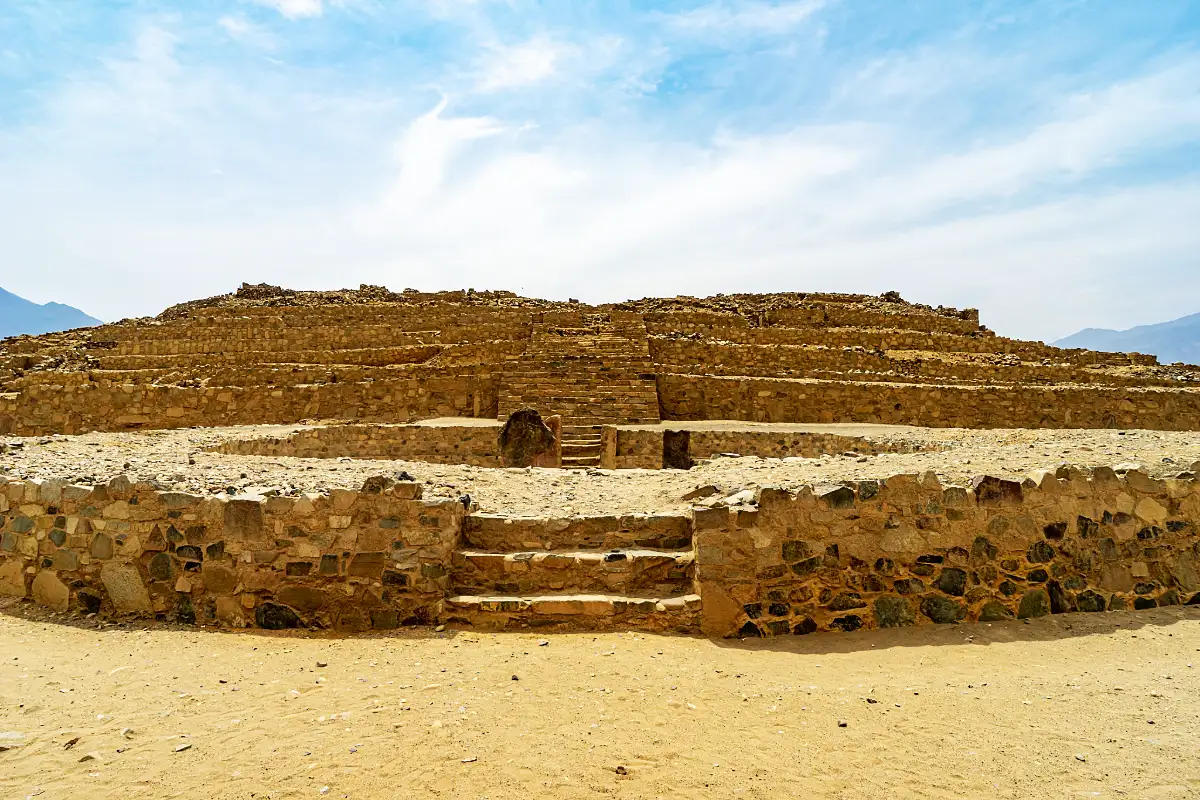
The Caral civilization developed between approximately 3000 and 1800 BC in the north-central region of Peru, with an important concentration of urban centers in the Supe Valley. For around 1,200 years, these communities transformed their settlements and built an organized society with monumental architecture, established authorities, and connections with other regions.
Origins and Early Settlements in the Supe Valley
Before large cities emerged, several communities already lived in the Supe Valley and along the nearby coast. Over time, some settlements grew and became more influential, including Caral, Chupacigarro, Miraya, and Lurihuasi. On the coast, Áspero became especially important because of its connection with fishing and marine resources.
By around 3000 BC, this process led to the development of increasingly organized centers with public buildings and spaces designed for collective activities.
Development and Consolidation of Caral Society
During the following centuries, Caral became the political and sacred capital of a network of centers throughout the Supe Valley. Miraya, Lurihuasi, and Chupacigarro formed part of this system, while Áspero, located near the coast, played a key role in supplying marine resources.
The expansion and renovation of public buildings reflect an increasingly complex social organization. These centers were connected through ceremonies, collective labor, and the exchange of products between the valley, the coast, and other regions.
Decline and Abandonment of the Main Centers
Between 2000 and 1800 BC, Caral and other urban centers in the Supe Valley entered a period of crisis. A prolonged drought reduced the availability of water, damaged agricultural fields, and decreased the food surpluses that supported the population and large public construction projects. With fewer resources and workers, renovations became smaller, some ceremonial buildings were ritually closed, and the ancient centers gradually lost their importance.
Eventually, much of the population left these settlements and moved to areas with better access to water and food, especially locations closer to the coast and other productive regions. Caral stopped functioning as the valley’s main center, although later populations continued some of its exchange networks and traditions in new settlements.
Social and Political Organization of the Caral - Supe
In Caral Peru, social organization, political authority, and religion were closely connected. Leaders coordinated collective labor, managed resources, and directed ceremonies that strengthened both community unity and their own authority.
Authorities, Elites, and Population Organization
Caral society was organized hierarchically. Ayllus were grouped into units known as pachacas, each led by a curaca or local chief. Several pachacas formed larger divisions called sayas. Above these authorities was the Huno, considered the ruler of the Supe River basin.
Differences among houses, public buildings, and discovered objects also show that groups with different levels of social status existed. Some people performed roles related to administration, ceremonies, and the organization of collective labor.
The Role of Urban and Ceremonial Centers
The different urban centers throughout the valley were connected to this form of organization. Each settlement may have brought together particular communities and served political, social, and ceremonial purposes. Within this network, Caral stood out as one of the most important centers, with large public buildings, plazas, and spaces for collective activities.
Economy of the Caral Civilization
Caral’s economy was based on the complementary relationship between agriculture in the valley, fishing along the coast, and exchange with other regions. This system provided a wide range of resources and supported the development of its urban centers.
Agriculture in the Caral Civilization
The land near the Supe River supported crops such as beans, lima beans, squash, achira, sweet potatoes, and cotton. Cotton was especially important because its fibers were used to produce textiles and fishing nets.
Fishing and the Use of Coastal Resources
Coastal communities, particularly those connected with Áspero, made use of fish and shellfish from the Pacific Ocean. Anchoveta was one of the most important resources and could be dried to preserve it and make it easier to transport to inland settlements.
Exchange Between the Coast, Highlands, and Rainforest
Caral maintained contact with communities in other parts of Peru. Through exchange networks, products that were not available in the Supe Valley arrived from the coast, the highlands, and areas near the rainforest.
Archaeologists have discovered seashells, minerals, and other materials from distant locations. These findings show that Caral formed part of an extensive network connecting different regions.
Religion of the Caral Civilization
The people of Caral developed a religious life closely connected with nature, the surrounding landscape, and the cycles of the sky. Ceremonies were held inside public buildings and included fire altars, ritual hearths, and offerings. Some rooms were even ritually sealed before they were no longer used.
The names of their gods are not known with certainty. This does not mean they had no deities, but rather that they left no written texts that would allow researchers to identify them. Archaeological evidence suggests that fire, mountains, and certain movements of the Sun and other celestial bodies held special meaning in their ceremonies and their understanding of the world.

Architecture of the Caral Civilization
Caral’s architecture reflects the high level of organization achieved by this civilization. Its urban centers included monumental buildings, plazas, residential areas, and public spaces that were constructed and renovated over several generations. The arrangement of these structures shows careful urban planning and a clear separation between ceremonial, public, and residential functions.
Pyramids and Monumental Buildings
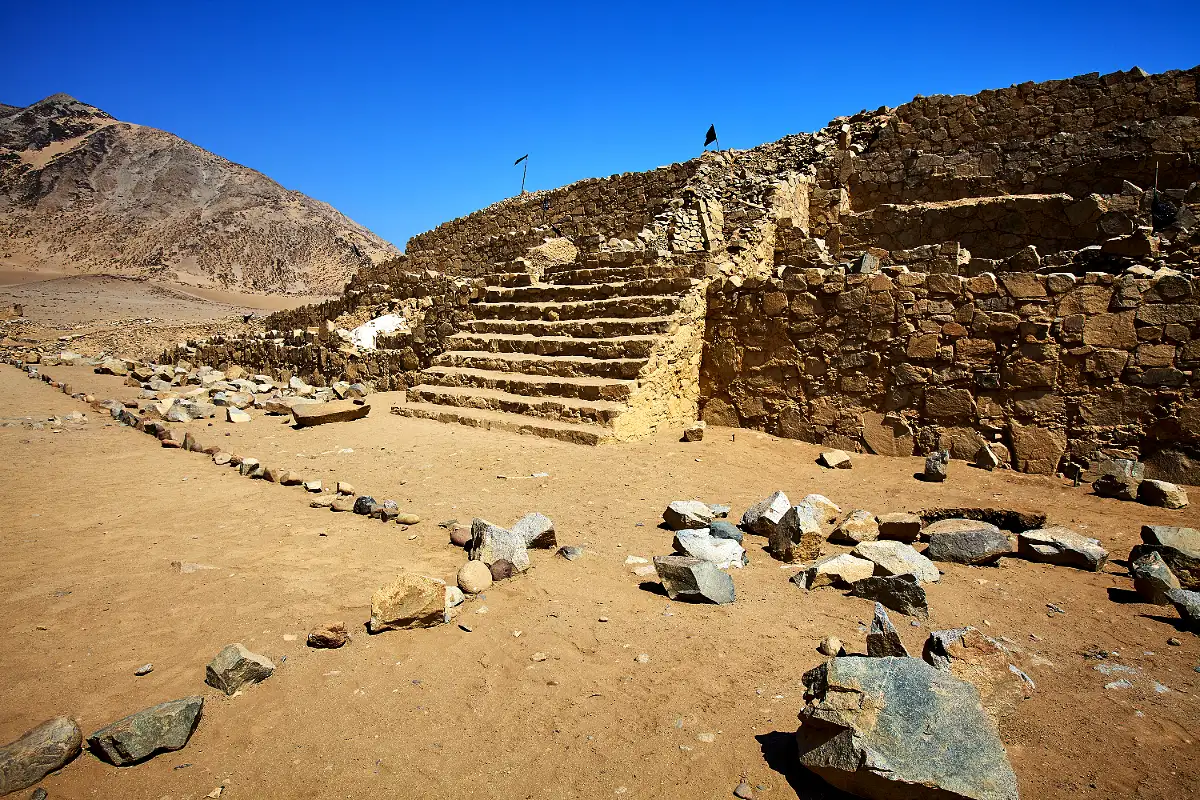
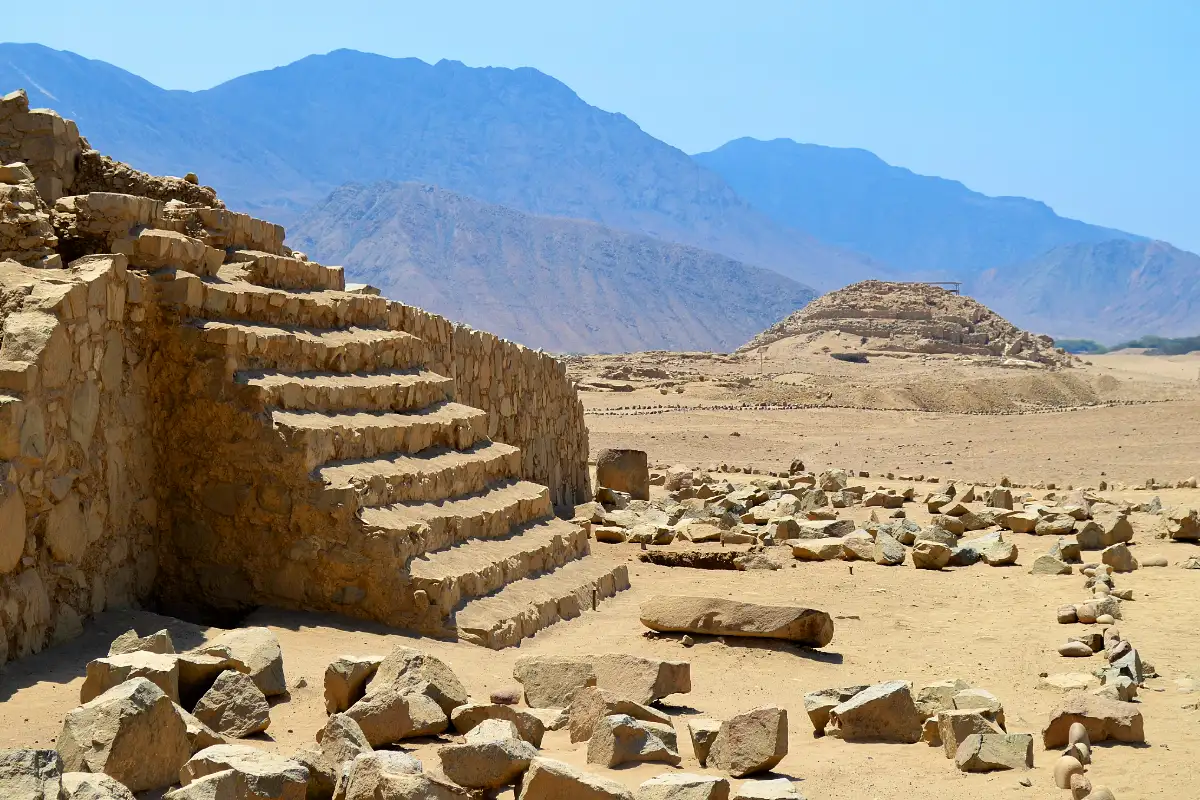
Pyramidal buildings were among Caral’s most representative structures. They were made up of superimposed platforms, stairways, and rooms. These buildings were used mainly for public and ceremonial activities, rather than as monumental tombs like the pyramids of Egypt.
They were also not built in a single phase. Excavations have revealed several expansions and renovations, showing that the buildings were transformed over many generations according to the changing needs of the population.
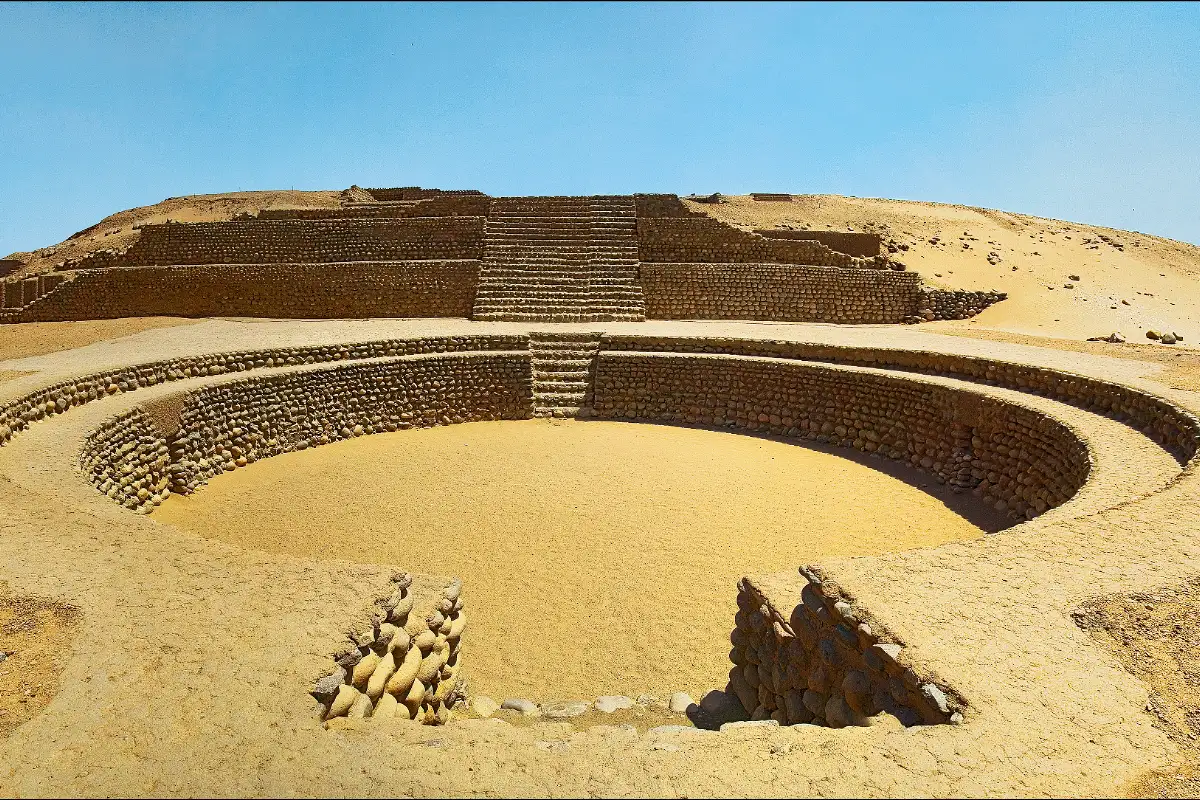
Sunken Circular Plazas
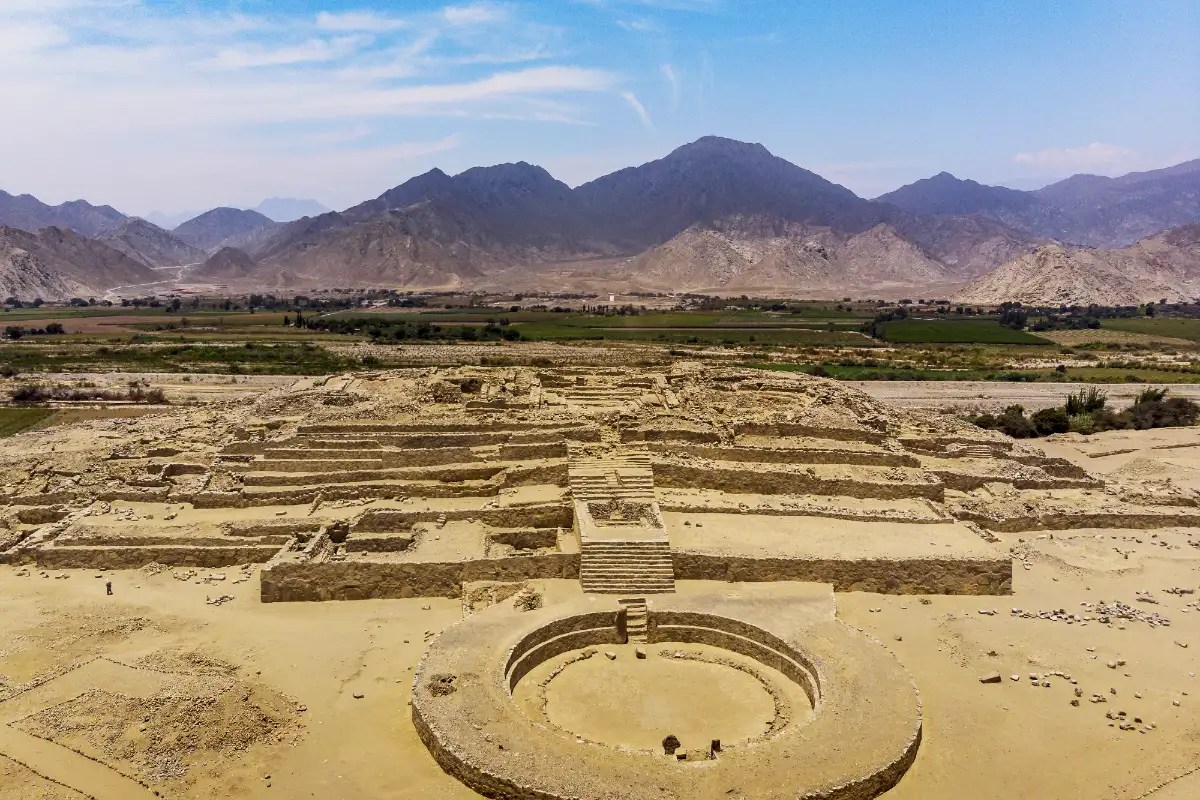
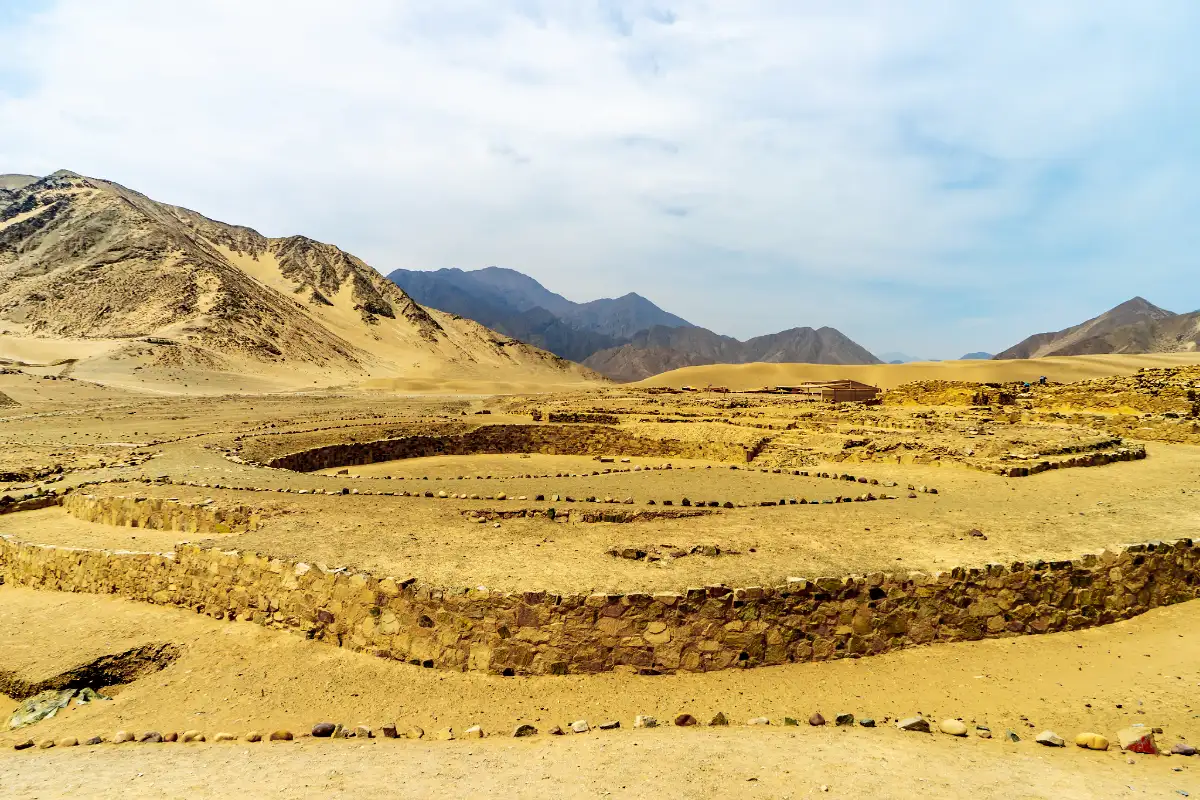
Sunken circular plazas were another distinctive feature of Caral architecture. They were constructed below ground level, usually beside public buildings, and included stairways leading into their interior.
These spaces were used for collective gatherings and ceremonies. They later became an architectural feature found in other settlements throughout the Central Andes.
Construction Techniques and Materials
Caral’s builders used materials available in the surrounding environment, including stone, clay, wood, and plant fibers. Walls were built with stone and mud mortar, while some structures used traditional techniques such as quincha.
They also used shicras, woven bags made from plant fibers and filled with stones. These bags were placed inside platforms as construction fill. The technique made it easier to organize and move large quantities of material and was widely used in Caral’s monumental buildings.
Organization of Urban Spaces
The Sacred City of Caral was divided into different sectors containing public buildings, plazas, and residential compounds. Monumental structures occupied prominent locations, while homes varied in size and position.
This arrangement reflects both the purpose of each area and the social differences among the city’s inhabitants. Caral also changed over time through the construction of new buildings and the renovation of existing structures.
Knowledge and Technology of the Caral Culture
Research shows that Caral civilization developed knowledge related to record keeping, sky observation, and music. These skills were connected with the organization of society, productive activities, and ceremonial life.
Quipus and Record-Keeping Systems
A collection of knotted cords discovered in the Sacred City of Caral was identified by researchers as a quipu. It is considered very early evidence of this type of record-keeping system in the Andes.
Although quipus are best known for their use during the Inca period, the Caral discovery shows that the use of cords and knots has much older origins. However, researchers still do not know exactly what information it recorded or whether it worked in the same way as later quipus.
Astronomical Knowledge and the Measurement of Time
The people of Caral observed the movement of the Sun, Moon, and other celestial bodies to recognize changes throughout the year. The orientation of certain buildings and stone alignments shows that they paid particular attention to specific moments in the solar cycle.
These observations may have helped them identify the seasons and organize activities such as planting, harvesting, and ceremonies. In this way, watching the sky served as an early method of measuring time and planning important community activities.
Music in the Caral Civilization
Music played an important role in Caral’s ceremonial activities. Among the most remarkable discoveries are 32 transverse flutes, as well as cornets, quenas, and antaras made mainly from animal bones.
These instruments show that Caral’s inhabitants understood the acoustic qualities of different materials and were able to produce a wide range of sounds. Although the melodies they performed are unknown, the discoveries confirm that music formed part of gatherings and rituals held in the city’s main public spaces.
What to See in the Sacred City of Caral
The Sacred City of Caral covers around 68 hectares and includes a central area with 32 public buildings, residential compounds, and two peripheral zones. A visit reveals how monumental buildings, plazas, and homes formed part of a carefully planned and hierarchical city.
Great Pyramid
The Great Pyramid is Caral’s largest pyramid complex in both area and volume. Its size, location, and connection with a sunken circular plaza suggest that it was one of the city’s most important public buildings. Ceremonial rooms and a fire altar with underground ventilation ducts are located at the top.
Temple of the Amphitheater
The Temple of the Amphitheater was one of the main buildings in Lower Caral and was closely connected with religious activities. It is a walled complex associated with a sunken circular plaza where collective ceremonies were held.
Archaeologists discovered 32 transverse flutes and 38 cornets here, one of the most important collections of musical instruments found in Caral. These discoveries show that music played a prominent role in the ceremonies performed in this area.
Pyramid of the Gallery
The Pyramid of the Gallery was one of Caral’s most important monumental buildings and is the third-largest of its pyramidal structures. Its name comes from an underground gallery built at the top, which could be entered through a narrow passage.
Ceremonial objects were also discovered inside this building, including worked whale vertebrae, musical instruments, and a collection interpreted as a quipu. These findings reinforce the importance of the people who directed the activities held there.
La Huanca Pyramidal Building
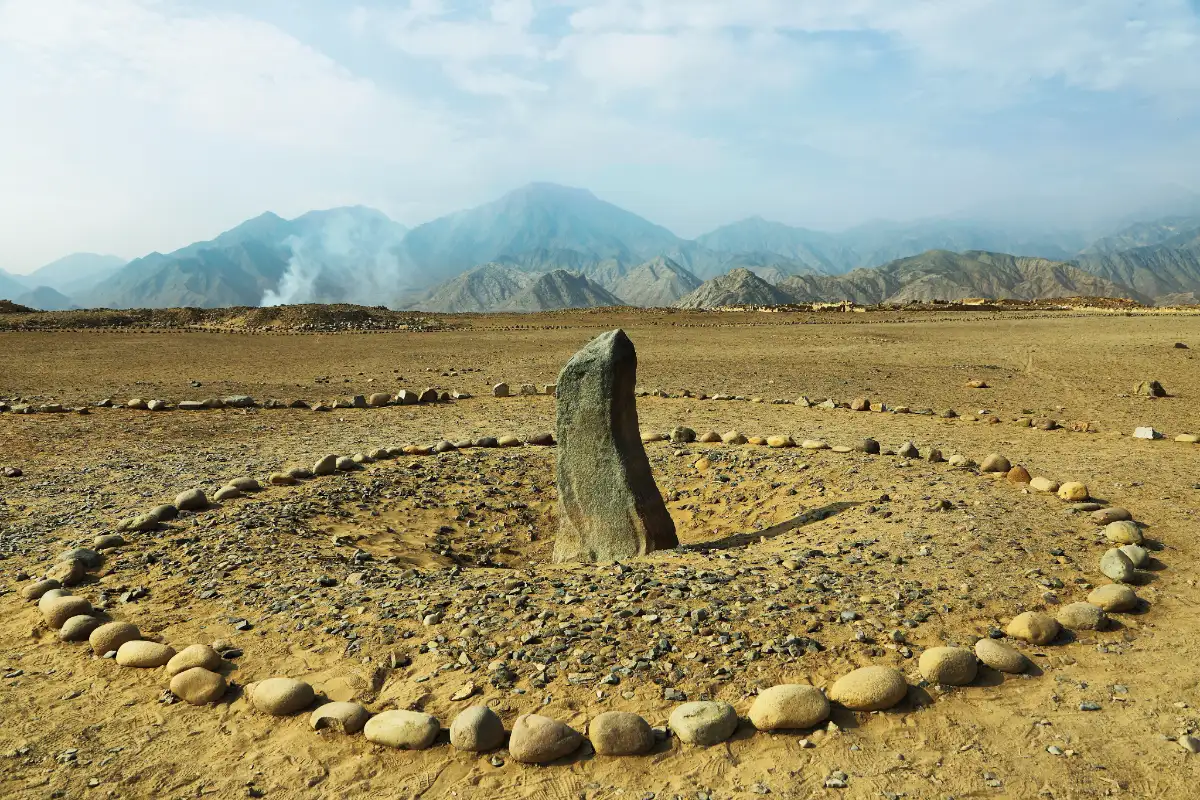
The La Huanca Pyramidal Building is located in the upper half of the city. In front of it stands a huanca, a stone monolith that may have served as an axis for aligning the building’s central stairway.
This relationship between the monolith and the structure is what distinguishes the complex and explains its name. A residential area connected with the people responsible for the building’s activities was also located beside it.
Residential Compounds and Other Areas of the City
Caral also preserves several residential areas. Differences in their location, size, materials, and finishes reveal the presence of groups with different levels of social status. Some homes were directly connected with the large public buildings, while others were located in peripheral areas.
The Larger Residential Compound, located beside the Central Plaza of Upper Caral, consisted of several groups of homes. Its characteristics suggest that it was occupied by an intermediate sector of the population, while larger residences with higher-quality finishes were associated with groups of higher social status.
Read later | Nazca Culture: A Story Written Across the Desert
How to Get to Caral from Lima
From Lima, follow the Pan-American Highway North to Supe, near kilometer 184. From there, take the Caral - Minas Ámbar road toward the Supe Valley and continue to the village of Caral. The journey usually takes around four hours, depending on traffic and the type of transportation used. From the visitor stop, continue on foot to the archaeological site’s reception center.
Opening Hours and Admission Fees
| Category | Information |
| Visiting hours | 9:00 am - 5:00 pm |
| Last entry | 4:00 pm |
| Adults | S/ 11 |
| College and university students | S/ 4 |
| School students | S/ 1 |
| Visitors under 18 | S/ 1 |
| Visitors over 60 | S/ 5.50 |
| Accredited teachers | S/ 5.50 |
Best Time to Visit Caral in Peru
Caral can be visited throughout the year, although conditions change depending on the season.
- Dry season, from May to November: The Supe River usually has a lower water level, and conditions are generally more comfortable for exploring the site.
- Rainy season, from December to March: Rainfall in the highlands can raise the level of the Supe River and affect some access routes, although the days in Caral are usually warm.
Tips for Visiting Caral
- Wear comfortable shoes, as the tour follows unpaved paths.
- Bring water, a hat, and sun protection because much of the circuit is exposed to the sun.
- Stay on the marked trails and avoid entering restricted areas.
- Arrive with enough time to explore the site before the last admission.
- To extend your visit, consider exploring other centers connected with this civilization, such as Áspero, Vichama, or Peñico.

Caral Civilization FAQs
Why is Caral considered a civilization?
Caral is considered a civilization because it developed organized urban centers, large public buildings, specialized economic activities, and a complex social structure. It also maintained exchange networks with other regions and practiced religious ceremonies that played an important role in its social organization.
How much time is needed to explore the Sacred City of Caral?
The visitor circuit takes approximately 1 hour and 30 minutes. When traveling from Lima, it is best to set aside a full day, including transportation time.
Can Caral be visited without a guide?
No. The Caral Archaeological Zone states that visitors must enter the circuit accompanied by a cultural heritage interpreter. This service can be hired at the reception center.
Is Caral suitable for children?
Yes. Caral can be an interesting and educational experience for families, especially for children who want to learn directly about Peru’s history and archaeology. Keep in mind that part of the visit involves walking outdoors, and all instructions provided by the site staff should be followed.
Are there places to eat near the Sacred City of Caral?
Yes. The Visitor Reception Center has a restaurant and traveler services, as well as a handicraft area and a small shop.
Can Caral - Supe be visited in one day from Lima?
Yes. Caral can be visited on a full-day trip from Lima. Because of the travel time and the length of the archaeological circuit, leaving early is recommended. The Caral Archaeological Zone also organizes one-day programs that may combine Caral with other archaeological sites.
What is the difference between the pyramids of Caral and those of Egypt?
Caral’s pyramids were stepped buildings with platforms, stairways, and rooms used for ceremonies and public activities. The Egyptian pyramids, by contrast, were massive stone structures mainly associated with the tombs and funerary complexes of pharaohs. Although both appeared thousands of years ago, they developed independently.

Add new comment