



Palcoyo is the most accessible rainbow mountain in Cusco and a quieter alternative to Vinicunca for travelers who want to enjoy unique colorful landscapes and great photos without a long, demanding hike. It is located south of Cusco, in the province of Canchis, and is usually visited as a full day trip from the city. The short walk takes you to its viewpoints, the Stone Forest, and, on clear days, gives you views of the snow-capped Ausangate mountain in the distance.
In this guide, you’ll find everything you need to plan your visit to this rainbow mountain alternative and understand what type of traveler should choose it over Vinicunca.
Palcoyo Mountain: Quick facts
| Palcoyo Mountain | Information |
| What is it? | Palcoyo is a group of 3 colorful mountains and an alternative to the more famous Vinicunca |
| Difference from Vinicunca | The route to Palcoyo is more accessible, less demanding, and less crowded than Vinicunca |
| Location | Vilcanota Mountain Range, Checacupe district, Canchis Province, 145 km southeast of Cusco |
| Altitude | 4,900 meters above sea level (16,070 feet) |
| Elevation gain | From 4,700 m (15,400 ft) at the start of the hike to 4,900 m (16,070 ft) / 200 m (656 ft) |
| Difficulty | Moderate |
| Hike | About 1 hour each way / 2 hours round trip, depending on your pace |
| Tour duration | Full day / about 13 hours |
| Best time to visit | May to October (dry season) |
| Entrance fees | 20 soles for foreign visitors / 15 soles for Peruvian visitors |
| Ideal for | Travelers and families with children looking for a less demanding alternative to Vinicunca |
| Not ideal for | People who are not acclimatized, have heart or respiratory conditions, are overweight, or are pregnant |
What is Palcoyo?
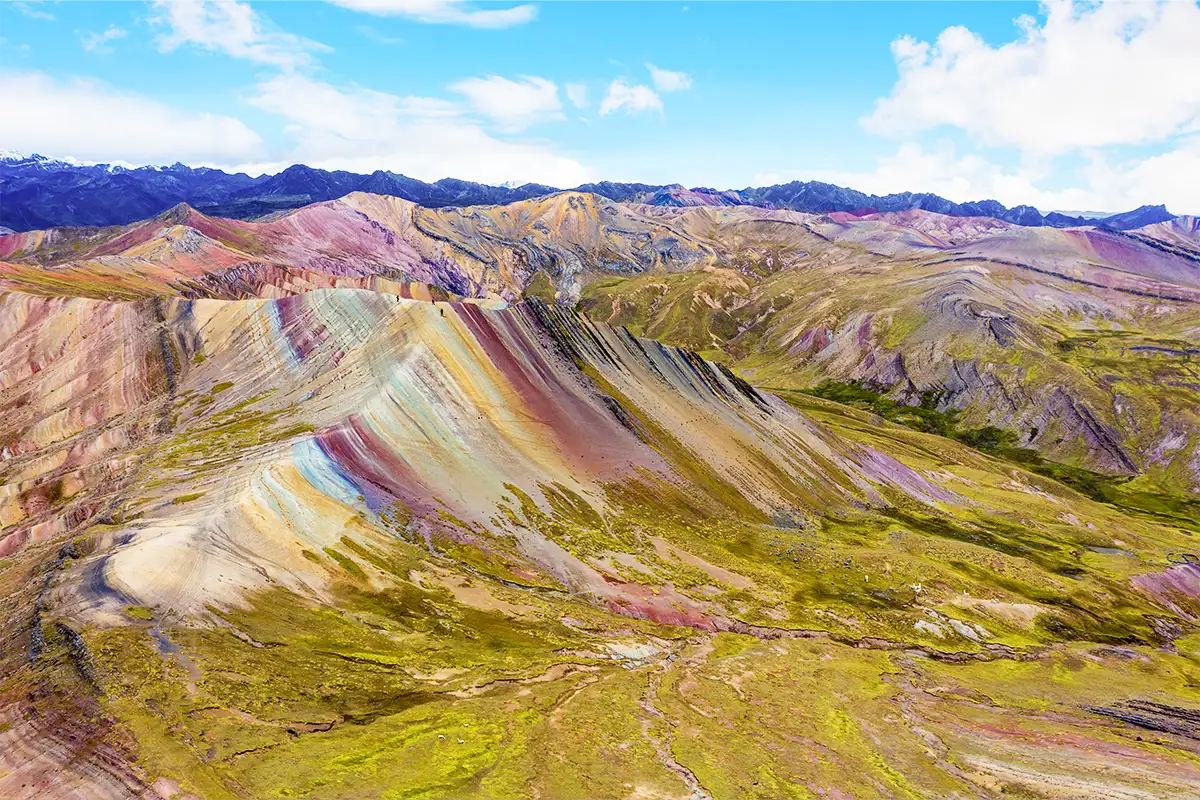
Palcoyo is less famous than Vinicunca, Cusco’s classic Rainbow Mountain. Cusco’s famous and more traditional Seven Colors Mountain. Many people call it Vinicunca’s “younger brother” or simply the alternative Rainbow Mountain, and with good reason. Unlike the traditional route, Palcoyo is much more accessible and easier to walk because it sits at a slightly lower altitude. Also, instead of just one mountain, you will find three colorful hills here, and as soon as you start the hike, you will already be surrounded by stunning scenery. Along the way, you may also see alpacas grazing, a stone forest with unusual shapes, and, on clear days, a distant view of the majestic Ausangate Mountain.
It was formed millions of years ago through the accumulation of layers of sediment (sand, clay, and minerals) transported by water and wind when the area was still underwater or in low-lying basins. With the collision of the Nazca and South American tectonic plates, these flatlands were dramatically uplifted to form the Andes Mountains, exposing these colorful layers vertically and diagonally.
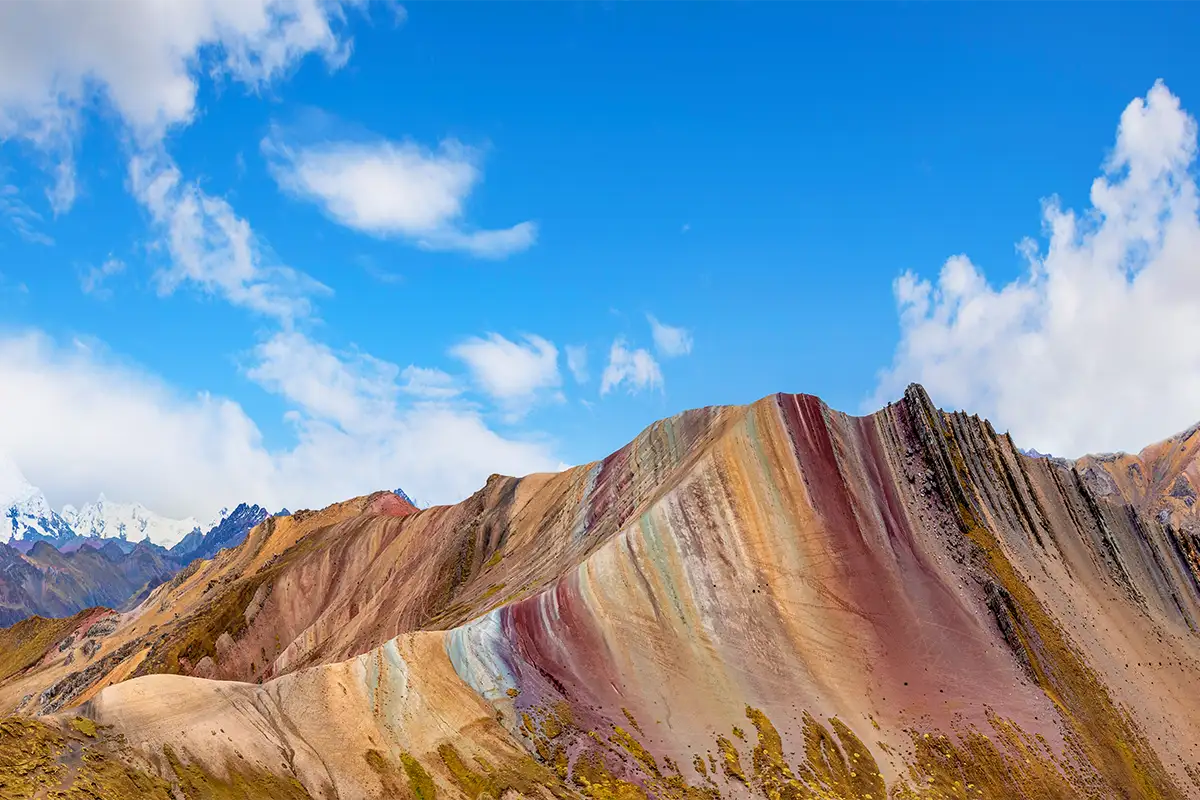
Recent climate change melted the snow that covered them, revealing their characteristic colored bands, which result from the oxidation of specific minerals upon contact with oxygen and water:
- Red/Pink: Red clay and iron mixed with sand.
- White/Cream: Quartz sand and calcium carbonate.
- Purple/Lavender: Mixture of clay with magnesium silicate and goethite.
- Green/Blue: Clays rich in ferrosilicates and oxidized copper.
- Yellow/Gold: Calcareous sandstones rich in sulfur and limonite minerals.
- Brown: A combination of magnesium-rich rocks.
Why is it worth visiting?
Because, unlike the traditional Rainbow Mountain, the Palcoyo hike gives you 3 colorful mountains to enjoy, along with a stone forest and a beautiful view of Ausangate Mountain on clear days. Not to mention that the route to get there is easier, more accessible, and less demanding than the path to its famous older sister.
Palcoyo or Palccoyo: which name is correct?
Palcoyo can also be written as Palccoyo. The name comes from Quechua, the ancient language of the Incas, and means “place with a fork” or “place where paths or rivers divide.” This meaning comes from two Quechua roots:
- P'allqa / Palqa: Means “fork,” “branching point,” or “division,” commonly used to describe where rivers, paths, or ravines split.
- -yoq: A possessive suffix that means “with” or “that has.”
The original farming community received this name because its first settlement was strategically located in an area where two rivers, the Ccayco and the Chillihuani, divide.
Palcoyo vs Vinicunca: Which one should you choose?
Factor | Palcoyo | Vinicunca |
Difficulty | Easier | More demanding |
Hike | Shorter | Longer |
Altitude | High, about 4,900 m above sea level | High, about 5,000–5,200 m above sea level |
Crowds | Less crowded | More popular |
Scenery | Three colorful mountains, the Red River, Stone Forest, Ausangate, and Checacupe Bridge | The classic Rainbow Mountain and the nearby Red Valley |
Best for | Families, beginners, and travelers who want to avoid a strenuous hike | Trekkers with better physical fitness |
>> If you want to know more, we invite you to read our article: Vinicunca vs Palcoyo: Which Rainbow Mountain Should You Choose in Peru?
Where is Palcoyo Mountain?
Palcoyo is located in the province of Canchis, in the district of Checacupe, about 145 kilometers southeast of Cusco. Getting there takes around 3 and a half hours by car. It is a somewhat remote area, which makes the experience feel more authentic and peaceful.
Once you arrive, a short and very scenic hike through colorful hills awaits you. The trail is accessible, not too demanding, and perfect for enjoying the landscape at a relaxed pace.
Key facts:
- Altitude: 4,900 meters (16,070 feet)
- Hiking time: Approximately 2 hours (round trip)
- Difficulty: Moderate
How to get to Palcoyo?
Like many day trips from Cusco, visiting Palcoyo means getting up early, but it is totally worth it. You can go with a tour (the easiest option), hire private transportation, or go on your own (a bit more challenging). Here are the main options:
Full-day Palcoyo tour from Cusco
Most tours leave early in the morning, with pickups from hotels in Cusco’s historic center or from specific meeting points between 4:00 and 5:00 a.m. The van ride takes about 3 and a half hours, and many agencies stop in towns such as Cusipata or Checacupe, where they usually offer breakfast at local restaurants. Some agencies include this service, while others do not, so make sure to check your itinerary details. After that, you will board your transport again and travel for another 30 minutes, following the striking Red River until you reach the parking area of the Palcoyo community (4,700 m), where the hike begins.
Here, your guide will give you a brief explanation about the area and share a few tips on how to use trekking poles properly. You can also use the public restrooms managed by the community and pay for your Palcoyo Mountain entrance ticket at the local checkpoint. Trekking poles and entrance tickets are often included in the tour price, but it is always best to check the details in advance.
At the start of the hike, your guide will lead the way. One advantage is that tour groups are usually smaller, unlike in Vinicunca. You will walk through beautiful high-Andean landscapes that take you past 3 colorful mountains until you reach the most scenic one. You will have time to take photos, enjoy the surrounding views, and admire the distant Ausangate snow-capped mountain. If there is enough time, you can also explore the Stone Forest, located right in front of the final viewpoint.
At the end of the hike, you will return along the same trail to the parking area, where you will take your transport back toward the towns of Cusipata or Checacupe. You will have lunch with your group at the same restaurants where you had breakfast, and then board your transport again for the return trip to Cusco.
- Departure time: Between 4:00 and 5:00 a.m.
- Return: Around 5:00 p.m.
- Average price: 80 USD for a group tour and 200 USD for a private tour.
- Advantage: Round-trip transportation, tour guide, and meals. You will not have to worry about anything. (The area does not have much public transportation for those who want to go on their own).
Keep in mind that these schedules may vary depending on the company. If there is extra time, some agencies usually stop at the beginning or end of the tour to visit the Checacupe Bridge, which is actually made up of 3 bridges side by side, each from a different period: Inca, colonial, and republican.
 |  |
On your own
Going on your own is also possible, but it requires more planning and is not always cheaper. There is no direct public transportation to Palcoyo, and getting back can be even more difficult, so you need to organize the route carefully. The trip there takes around 3 to 4 hours.
First, go to the Cusco - Sicuani bus terminal, located at Av. Huayruropata 1703, Cusco (reference: behind the Casa de la Juventud Indoor Coliseum). From there, take a bus and tell the driver that you want to get off in the town of Checacupe.
After about 3 hours of travel, you will need to get off near the Checacupe Bridge. You can take the opportunity to have breakfast here, just like many tours do.
Next, you will need to take another form of transport, such as a taxi or local vehicle, to the trailhead. This is the same route used by tours. This part can be tricky because there is not much public or private transport leaving from that area. If you find one, agree on the price with the driver beforehand and ask them to wait for you for about two hours and take you back to Checacupe, since there is also no public transportation returning from the mountain.
From the parking area or starting point, there is a main dirt trail that is well defined and later turns into a paved and stone path. It is a single trail that follows the side of the mountain, so you only need to follow the clear route.
Once the taxi drops you back in Checacupe, you can have lunch there. Then, simply stand by the main road and wait for a bus or shared van heading back to Cusco. They pass by quite often.
- Departure time: Between 4:00 and 4:30 a.m.
- Return: Around 6:00 p.m.
- Average price: 6 USD for the Cusco - Sicuani - Cusco bus / 30 - 45 USD round trip with 2 hours of waiting time by taxi / 25 USD for breakfast and lunch / 5 USD for the Palcoyo entrance ticket / TOTAL = 66 - 81 USD.
- Advantage: The trip can be a little cheaper than taking a tour.
Private transportation
You can also hire a private car or van to take you directly to Palcoyo. It is more expensive, but also more practical. The total cost is usually between 450 and 500 soles (about 150 USD).
Our recommendation
Having everything organized makes the trip much easier. For your safety and comfort, we recommend taking the Palcoyo Rainbow Mountain tour with a travel agency.
Palcoyo altitude and difficulty
Palcoyo is visited at high altitude, so the hike can feel more demanding than it looks. Although the trail is short and does not require technical experience, it is best to arrive in Cusco acclimatized, walk slowly, and go at your own pace.
How high is Palcoyo?
Palcoyo Mountain is located at around 4,900 meters above sea level (16,070 feet). This altitude can cause tiredness, shortness of breath, or headaches, especially if you come directly from lower areas. The hike is short, but the altitude should be taken seriously.
Altitude at each point of the route
The route usually begins near 4,700 m at the parking area. From there, you gradually walk up toward the viewpoints, located at around 4,850 to 4,900 m. The Stone Forest is located at almost 5,000 m.
Is it difficult to hike Palcoyo Mountain?
Hiking in Palcoyo is not difficult because of the distance or the terrain, but because of the altitude. The trail is clear and has a moderate slope, but there is less oxygen. That is why it is best to walk slowly, take breaks, and avoid unnecessary effort.
Altitude sickness in Palcoyo: how to prevent it
To help prevent altitude sickness, acclimatize first in Cusco (3,399 m):
- Sleep well
- Avoid drinking alcohol the night before
- Avoid very spicy or heavy meals that take longer to digest, such as meat, in the days before the hike
- Do not do physically demanding exercise in the days before the hike
- Drink plenty of water.
During the hike, keep a slow pace and breathe calmly. If you have a strong headache, nausea, or dizziness, let your guide know.
How many days should you acclimatize in Cusco before going?
It is best to spend at least 1 or 2 days in Cusco before visiting Palcoyo. If you are coming from sea level, this time helps your body adjust better. During those days, avoid intense hikes and choose light activities.
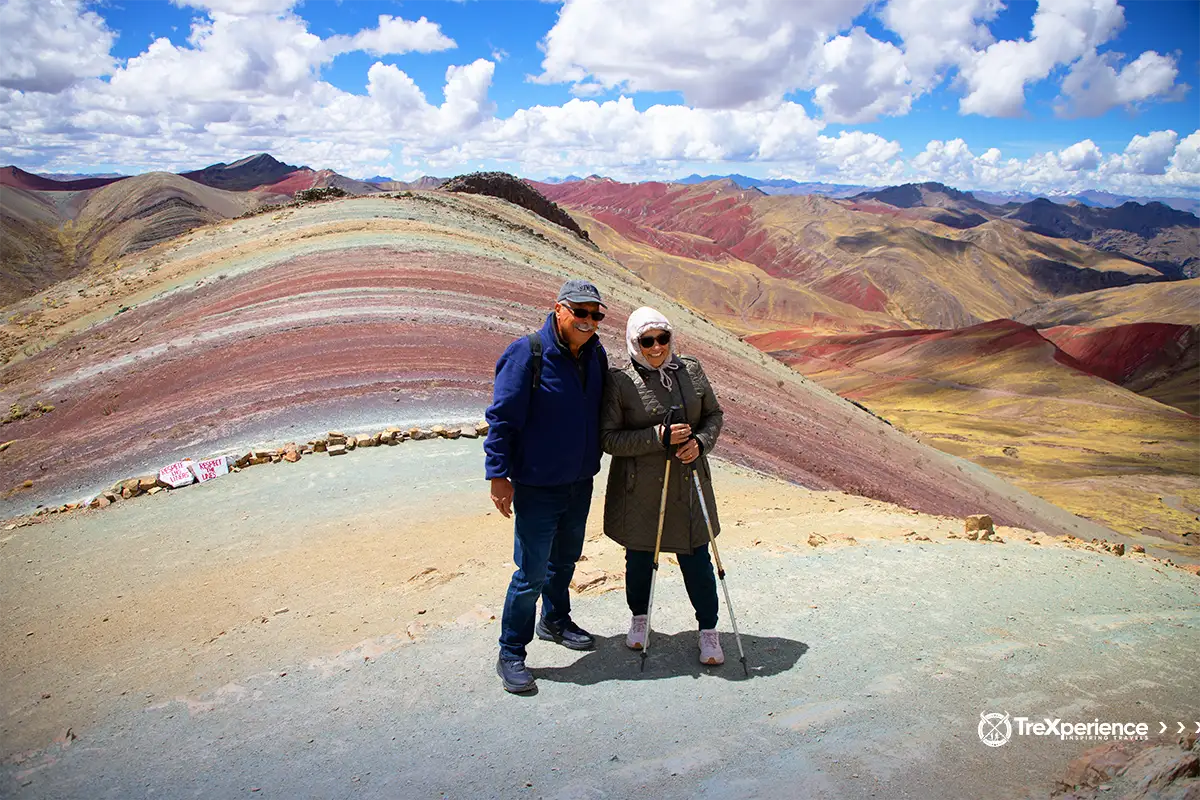
Who should avoid this excursion?
Palcoyo is not recommended for people who are not acclimatized, have heart or respiratory problems, uncontrolled high blood pressure, people in the later stages of pregnancy, or strong symptoms of altitude sickness. If you have a medical condition, consult a professional before traveling.
What to see at Palcoyo Mountain?
The hike
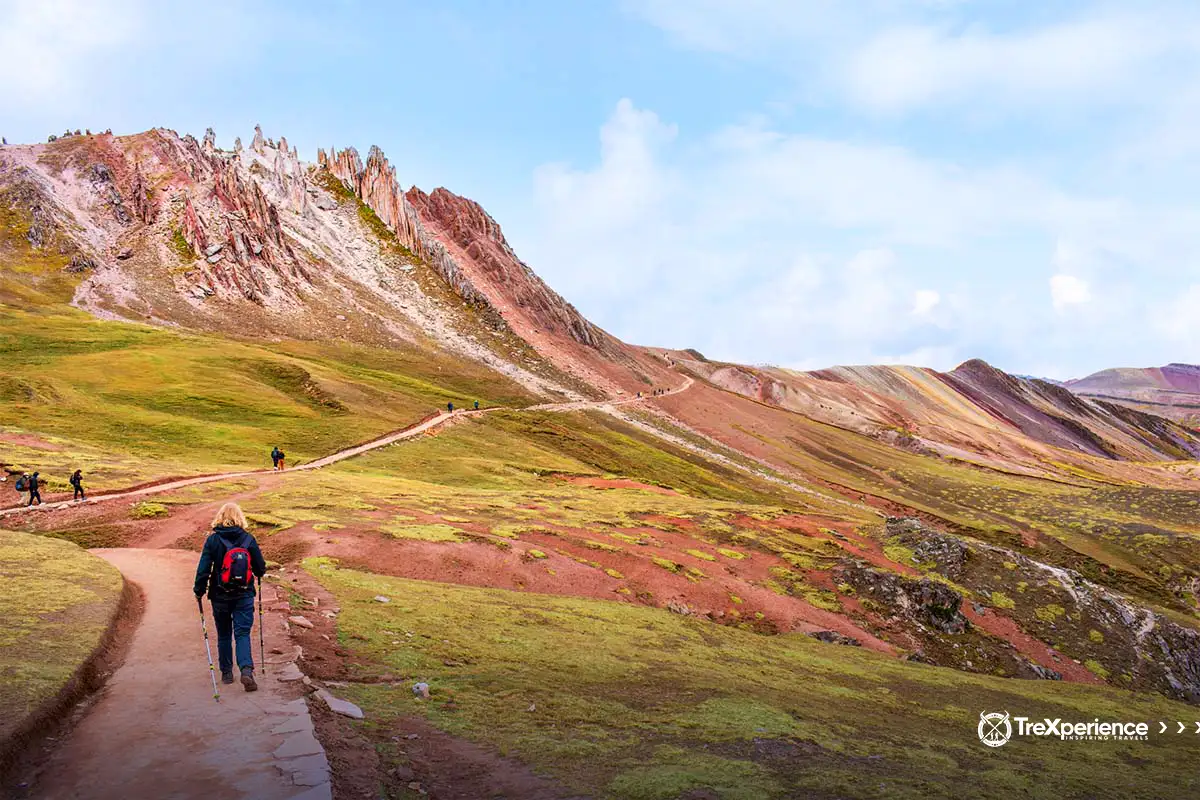
Palcoyo is one of those places that surprises you from the very beginning. The trail starts right after you leave the community parking area, so you do not need to walk far to reach the beautiful part: as soon as you arrive, you are already surrounded by mountains. The first section is gentle, with a barely noticeable incline. The trail is easy to see, and it is hard to get lost. The outbound leg is 1.5 kilometers and takes approximately 1 hour. The return leg is the same distance and time.
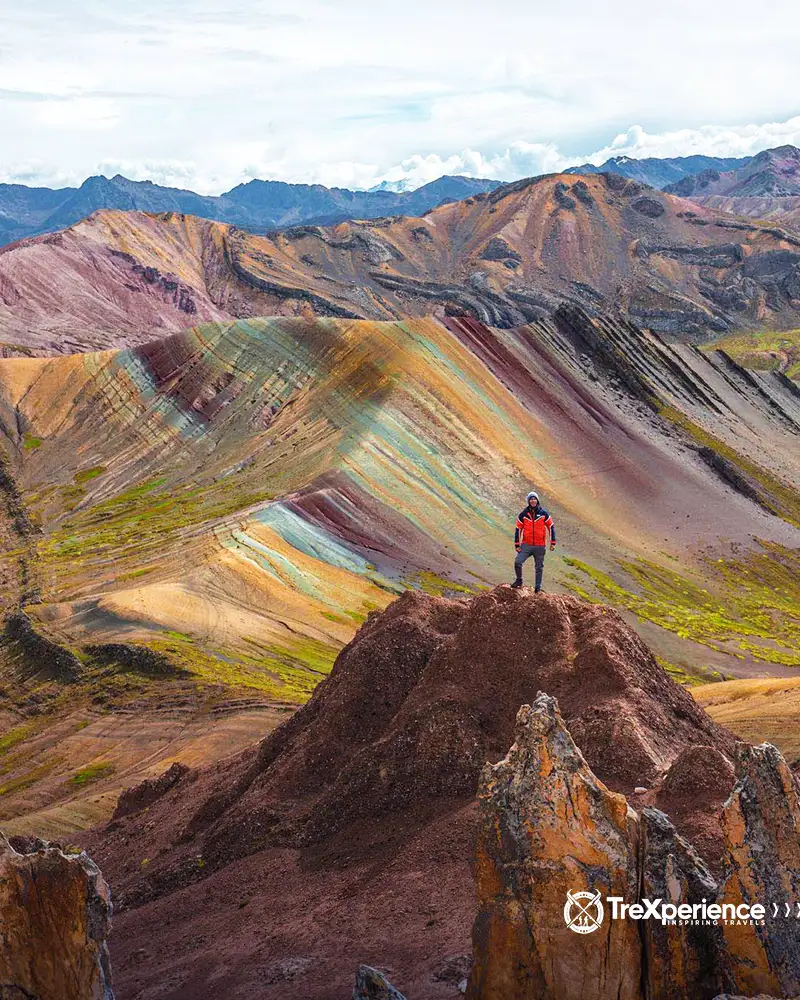
The three rainbow mountains
In just a few minutes, you will be standing in front of the first colorful hill. From there, the trail rises gently toward other slopes that are just as impressive. The terrain is not difficult, so it does not feel like a demanding hike. Even so, the altitude can be felt, so it is best to walk calmly and at your own pace. This way, you can enjoy the views, which appear from the start of the trail and keep surprising you along the way.
After that, you will come across the second and third rainbow mountains, with wide slopes that let you appreciate their colors even better. The viewpoints are located right in front of them, and unlike Vinicunca Rainbow Mountain, these mountains are only a few steps away from your view. In total, you can spend between one and two hours exploring Palcoyo.
The Red River
After breakfast in Checacupe, your transport will take you along an unpaved road to the starting point of the hike. This road runs parallel to a river with a reddish tone; local community members call it Puka Mayu (Puka = red, Mayu = river). In some sections, it is also known as Yawar Mayu (River of Blood).
During the rainy season, the water carries minerals down from the red hills of Palcoyo, turning an intense reddish color due to the high concentration of iron oxide. In the dry season, the water level drops and the color fades. Seeing it is quite a spectacle, especially if you visit during the rainy season.
The Stone Forest
After seeing the rainbow mountains, you can hike a little higher to a less-visited area: the famous Stone Forest.
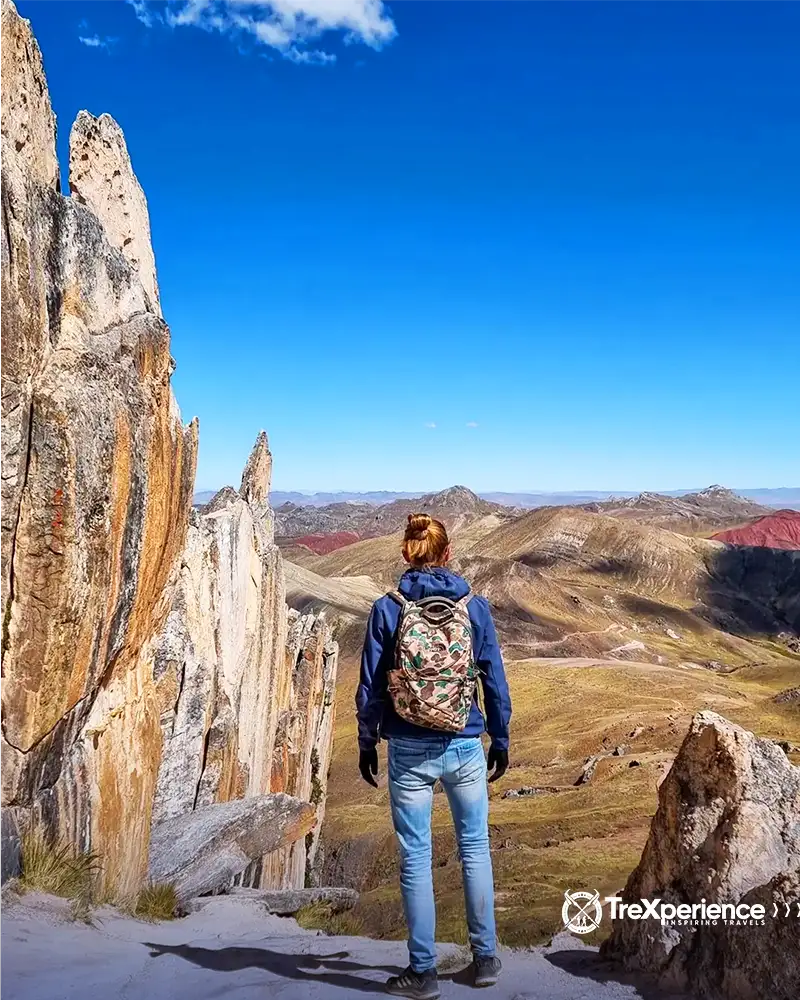
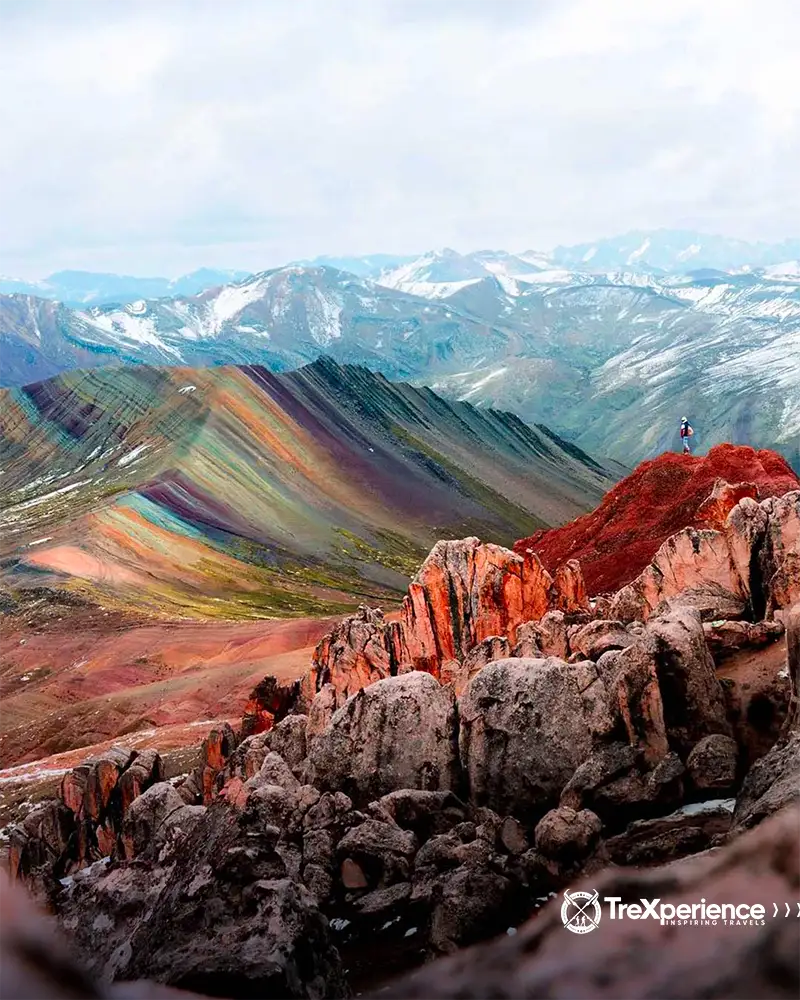
It is an impressive area of limestone rock formations that rise vertically toward the sky, shaped over millions of years by wind, rain, and ice erosion. It is located at almost 5,000 meters above sea level, in front of Palcoyo’s Seven Colors Mountain. Locals call it a “forest” because, from a distance, the cluster of stone silhouettes creates the amazing impression of a dense forest of dark, petrified trees.
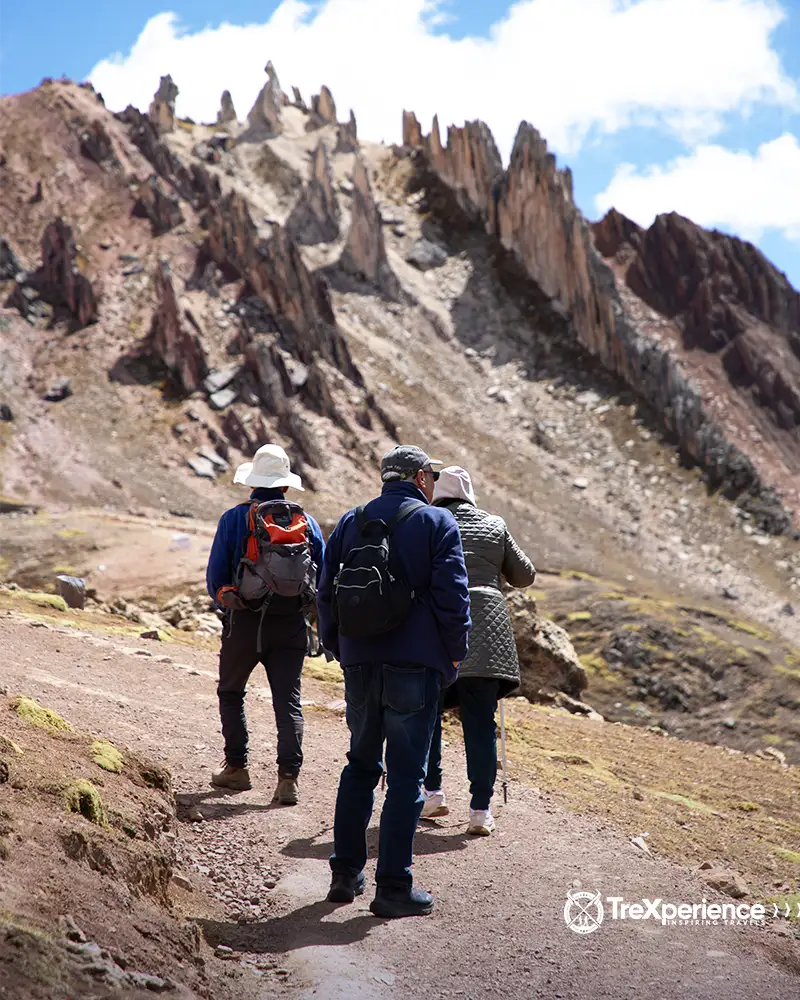 |  |
Photos do not do it justice: the landscape looks like something from Mars. If you still have energy for one last effort, it is absolutely worth hiking up there. Do not forget to stay hydrated and eat a few energy snacks; at that altitude, any extra energy helps. Also, remember to take your trash back with you.
View of Ausangate Mountain
On clear days, you can see this impressive snow-capped mountain in the background behind the rainbow-colored hills. Ausangate Mountain was an important Apu, or Inca deity, believed to protect the communities of Cusco. It rises to 6,384 m, and its white summit adds beauty to any postcard view of Cusco and its surroundings.
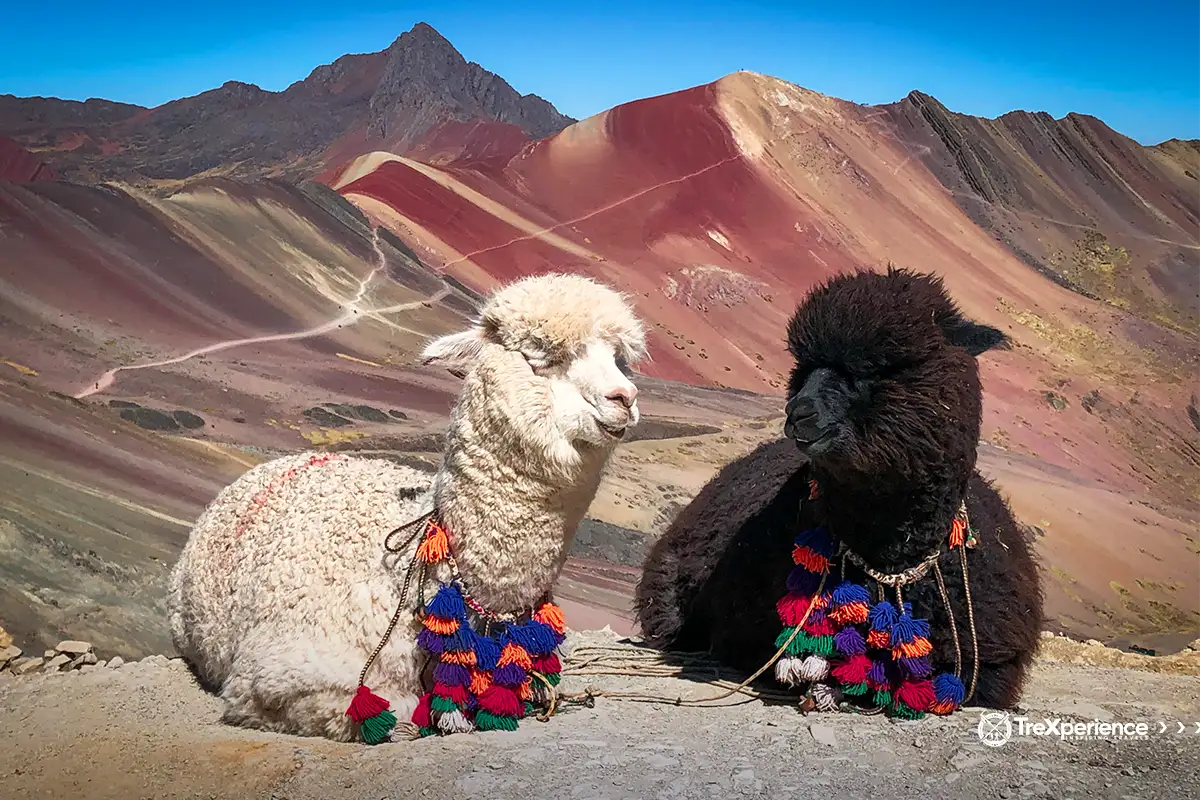
The alpacas
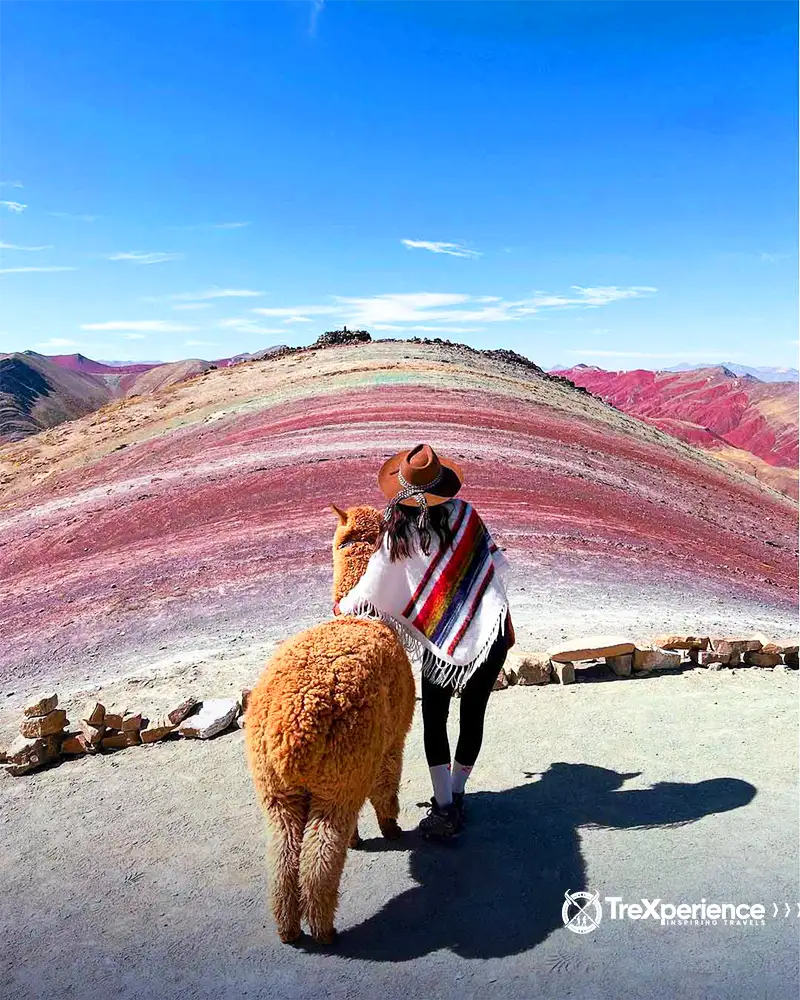
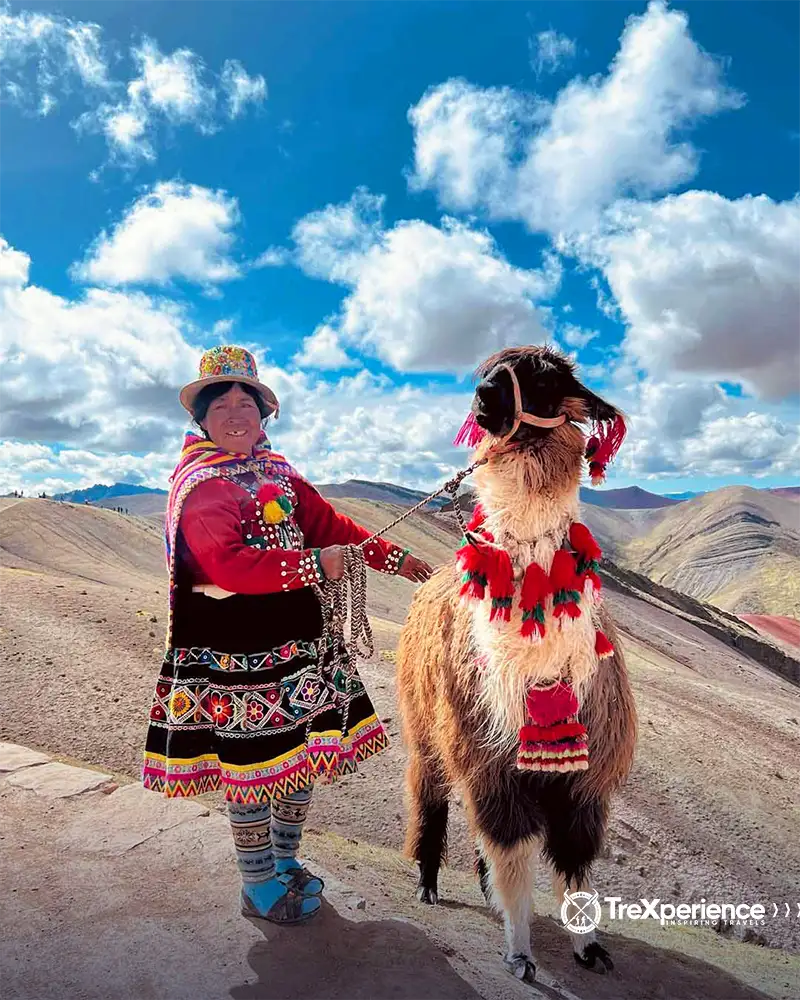
Alpacas are part of the scenery. They are everywhere, calmly grazing near the trail, and they seem made for this climate with their thick, elegant wool. Sometimes they are accompanied by their owners, who live in nearby communities.
If you are lucky, you can take a photo with one, after agreeing with its owner; some may ask for a small tip. People are friendly and may even stop to chat for a while. You do not need to speak Quechua to feel welcome: a smile and a few simple words are enough.
Checacupe Bridge
In the town of Checacupe, there are three bridges built in different periods over the Pitumarca River: an Inca-style rope bridge, a colonial stone bridge, and a republican iron bridge. Together, they show three periods of Peru’s history in one place. Some tours visit them at the beginning or end of the route, depending on the time available.
Best time to visit Palcoyo
The best time to visit the Palcoyo mountain range is during the dry season, from May to October. During these months, the days are sunny, the skies are usually clearer and there is a very low chance of rain, giving you excellent visibility to enjoy the colors of the mountains and the snow-capped Ausangate. Still, this does not mean bad weather is impossible: this part of the Andes can sometimes have short storms with sudden drizzle, although nothing like the rainy season.
If you travel during the rainy season (from November to March), daytime temperatures are slightly warmer (10 °C to 17 °C), but there is a higher chance of fog, hail, or snow covering the landscape. The trail can also become slippery.
Avoid traveling between:
- January to March: heavy rain, muddy trails, and cloudy skies. Snow is also possible, covering the mountain's colors.
Weather
Palcoyo has a cold high-mountain climate because it is located above 4,700 meters above sea level. Temperatures can change a lot between day and night:
- During the day (with sun): Temperatures range between 12 °C and 18 °C. The sun is usually very strong, but the high-altitude wind keeps the air feeling cool.
- At night and early in the morning: Temperatures can drop sharply below 0 °C, even reaching -5 °C during the coldest months (June and July).
Entrance fee and tours
Before visiting Palcoyo, consider three main costs: the mountain entrance ticket, transportation, and the services included if you book a tour. Prices can vary depending on the season, the agency, and the local community, so it is always best to confirm them before booking.
Palcoyo entrance fee
The entrance fee is paid at the Palcoyo checkpoint, located in the parking area at the start of the hike. The ticket costs S/20, or about US$6, for foreign visitors and S/15, or about US$4.5, for Peruvian visitors. Bring cash in soles, as card payments and foreign currency are not accepted.
What a tour usually includes
- Round-trip tourist transportation, with pickup and drop-off at your hotel in Cusco or at a specific meeting point in the city
- Bilingual tour guide
- Breakfast and lunch
- Entrance ticket to the Rainbow Mountain
What is usually not included
- Trekking poles
- Tips
- Snacks
- Travel insurance
 |  |
What to bring to Palcoyo?
- Hiking shoes or sneakers with good grip
- Thick socks
- Hiking pants
- Thermal layers
- Breathable T-shirt
- Fleece jacket or sweatshirt
- Windbreaker or waterproof jacket
- Sun hat and warm hat
- Gloves
- Rain poncho
- Sunglasses
- Trekking poles
- Sunscreen
- Water
- Snacks
- Altitude sickness medication
- Cash, preferably in soles
- Personal medication
Final recommendations
- Acclimatize in Cusco first: Do not visit Palcoyo (4,900 m) on your first day in Cusco (3,399 m). Spend at least 1 or 2 days in the city to adjust to the altitude.
- Check the weather before you go: During the rainy season, the trail can become slippery or may even be covered with snow.
- Dress in layers: The weather is cold and can change quickly. Wear warm clothes, but remove layers as you walk and the sun comes out.
- Walk at your own pace: Walk slowly, take short steps, and stop to breathe when you need to. It is not a race.
- Use strong sun protection: Because of the altitude, UV radiation is very strong. Apply high-protection sunscreen before and during the hike.
- Buy coca leaves or bring “Sorojchi Pills”: Chewing coca leaves can give you energy. The pills may help reduce symptoms of altitude sickness.
- Book with a reliable agency: Make sure the tour includes the entrance ticket, breakfast, lunch, and transportation. This helps you avoid unexpected costs.
Extra tip
Going early has two big advantages: there are fewer people, and the morning light brings out the colors. The sky is also usually clearer at that time of day.
FAQs
How many kilometers do you hike in Palcoyo?
In Palcoyo, you hike about 3 km round trip, depending on whether you only visit the main viewpoints or also continue up to the Stone Forest. The total elevation gain is around 200 meters, but it feels more demanding because of the altitude, as the route starts near 4,700 m and reaches around 4,900 m.
Can you visit Palcoyo with children?
Yes, children can visit Palcoyo, as long as they are well acclimatized to the altitude, in good physical condition, and not recovering from a recent illness. The recommended age to visit Palcoyo is 13 years and older.
Are there horses in Palcoyo if I get tired?
No. Unlike some more commercial routes, Palcoyo usually does not offer horse rentals for the hike. The walk is short and has a gradual slope, but if you depend on a horse because of health, mobility, or fatigue, it is better to visit only the main viewpoints and avoid going up to the Stone Forest.
Is it worth hiking up to the Stone Forest, or are the viewpoints enough?
If you are well acclimatized and still have energy, it is worth hiking up to the Stone Forest because it offers a wider view of the landscape. But if you feel short of breath, have a headache, or feel very tired, it is better to stay at the main viewpoints. That section is steeper and reaches 5,000 m.
What should I do if I feel sick from the altitude during the hike?
If you get a strong headache, nausea, dizziness, or intense shortness of breath, stop walking, tell your guide, and do not continue climbing. The safest thing to do is rest, drink water, and go down if the symptoms get worse. The CDC says that altitude sickness symptoms often improve with descent, and you should not keep going higher if you feel worse.
Are there bathrooms, food, or water in Palcoyo?
Yes, but the services are basic. Near the checkpoint or starting area, there are usually bathrooms and small stalls where you can find water, soft drinks, fruit, candy, or snacks. Do not rely only on these services: bring cash in soles, enough water, and something light to eat during the hike.
What should a safe Palcoyo tour include for trekkers?
A safe Palcoyo tour should include a guide, round-trip transportation, entrance ticket, meals, a first aid kit, and, ideally, oxygen for altitude-related emergencies. Before booking, also ask about the group size, hiking pace, time at the viewpoints, and what happens if a traveler needs to return early.

Add new comment