



Located in Cusco’s South Valley, Andahuaylillas features historic Andean heritage, colonial art, traditional architecture, and the Church of San Pedro Apóstol known as "The Sistine Chapel of America.
What is Andahuaylillas?
Andahuaylillas is a historic Andean village in Cusco with a past that spans the pre-Inca, Inca, and colonial periods.
Its strategic location between the Inca capital of Cusco and other important settlements in southern Peru placed it along key routes used for trade, communication, and cultural and religious exchange.
What Does Andahuaylillas Mean?
The origin of the name Andahuaylillas is uncertain. Several theories have been proposed about the origin of the name:
- Tiahuanaco culture: possibly related to an ancient settlement known as Antahuaylla.
- Chanca culture: possibly derived as a diminutive form of Andahuaylas, a region associated with the Chanca culture.
- Inca: possibly derived from the Quechua word Antahuaylla, commonly interpreted as “copper-colored meadow” or “meadow of deer”.
- Colonial period: the town was known as San Pedro de Antahuaylla la Chica, a name that gradually evolved into Andahuaylillas
Where Is Andahuaylillas?
Andahuaylillas is located about 24.9 miles (40 km) southeast of Cusco near the Vilcanota River. It lies along the Interoceanic Highway and passes through traditional towns such as Saylla, Huasao, Tipon, Oropesa, Huaro and Urcos.
Andahuaylillas Altitude and Weather
Andahuaylillas sits at approximately 10,236 ft (3,120 m) above sea level, slightly lower than the city of Cusco. Because of its lower elevation, the climate is generally a little warmer and more humid than in Cusco, creating favorable conditions for agriculture, one of the village’s main economic activities.
How to Get to Andahuaylillas?
You can reach Andahuaylillas by road, either by private car, bus, or on an Andahuaylillas tour as part of a Cusco South Valley excursion. A journey to Andahuaylillas from Cusco takes approximately one hour.
If you want to visit Andahuaylillas on your own, you can take a public bus heading to Urcos (as Andahuaylillas is on the way to Urcos). Buses depart from the area in front of Cusco’s Regional Hospital. A one-way ticket costs approx. US$2 dollars or S/ 7 soles.
Visiting Andahuaylillas on a South Valley Tour
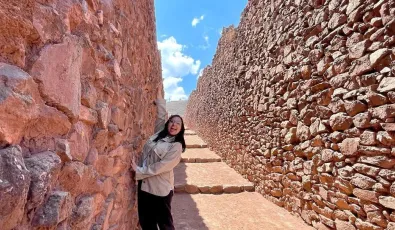
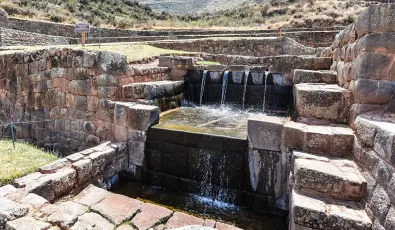
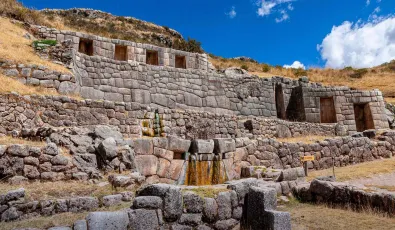
Andahuaylillas can be visited on a half-day tour from Cusco. The classic itinerary includes the Andahuaylillas Sistine Chapel and its remarkable artistic heritage, along with two important archaeological sites: Tipon and Pikillacta.
Tipón is known for its impressive Inca hydraulic engineering, while Pikillacta preserves significant remains of the pre-Inca Wari culture, offering a broader view of the different civilizations that shaped the southern region of Cusco.
Cusco South Valley Tour Details
- Start / End Time: 8:00 a.m. to 2:00 p.m.
- Duration: 5–6 hours
- Difficulty: Easy
- Tour Focus: Culture, history, and art
See more | South Valley Tour from Cusco
Andean Baroque Route
Another way to visit Andahuaylillas is on a religious and cultural tour focused on the Jesuit legacy and the Andean Baroque Route in Cusco’s South Valley. This tour includes the churches of Andahuaylillas, Huaro, and Canincunca, each known for its colonial art, religious heritage, and distinctive Andean Baroque style.
Andahuaylillas Church Visiting Hours
The Church of San Pedro Apóstol de Andahuaylillas (Saint Peter the Apostle of Andahuaylillas) is included in the Andean Baroque Route Tourist Ticket, which offers access to the three churches in Cusco’s South Valley or to the complete route, including the Church of the Society of Jesus in Cusco Main Square.
| Church | Opening Hours |
| Church of San Pedro de Andahuaylillas | Mon to Sun, 7:30 am - 5:30 pm |
| San Juan Bautista, Huaro | Mon to Sun, 8:30 am - 4:30 pm |
| Virgen Purificada, Canincunca | Mon to Sun, 8:30 am - 4:30 pm |
| Church of the Society of Jesus, Cusco Main Square | Mon to Sun, 9:00 am - 11:20 am and 1:00 pm - 5:20 pm |
Opening hours may change during religious celebrations and special festivals. On certain important dates in the local calendar, tourist access to the church of Andahuaylillas may be temporarily restricted.
| General Public | Students and Peruvian Visitors | |
| South Valley Churches: Andahuaylillas, Huaro, and Canincunca | ~US$5.5 or S/ 18 PEN | ~US$3 or S/ 10 PEN |
| Complete Andean Baroque Route: Andahuaylillas, Huaro, Canincunca, and the Church of the Society of Jesus in Cusco | ~US$7.5 or S/ 25 PEN | ~US$4.5 or S/ 15 PEN |
*Both tickets are valid for 7 days. Payment is accepted in cash only, in Peruvian soles. Card payments are not accepted.
Is Andahuaylillas Church included in the Cusco Tourist Ticket?
No. The Church of San Pedro Apóstol is not included in the Cusco Tourist Ticket. Visitors need the corresponding ticket for the Andean Baroque Route to enter.
Best Time to Visit Andahuaylillas
Andahuaylillas village and the Andahuaylillas Church can be visited throughout the year, although each season offers different conditions.
- April to November: Dry and clear days are more common, making this an excellent time to explore the town and other attractions in the South Valley.
- December to March: Rainfall is more frequent, but the countryside becomes greener and the surrounding farmland reaches its most vibrant colors.
What to Do in Andahuaylillas
Although Andahuaylillas is best known for its famous church, the village is also worth exploring for its traditional architecture, handicrafts, and peaceful atmosphere. Here are some of the best things to do in Andahuaylillas during your visit.
Walk Around the Andahuaylillas Historic Center
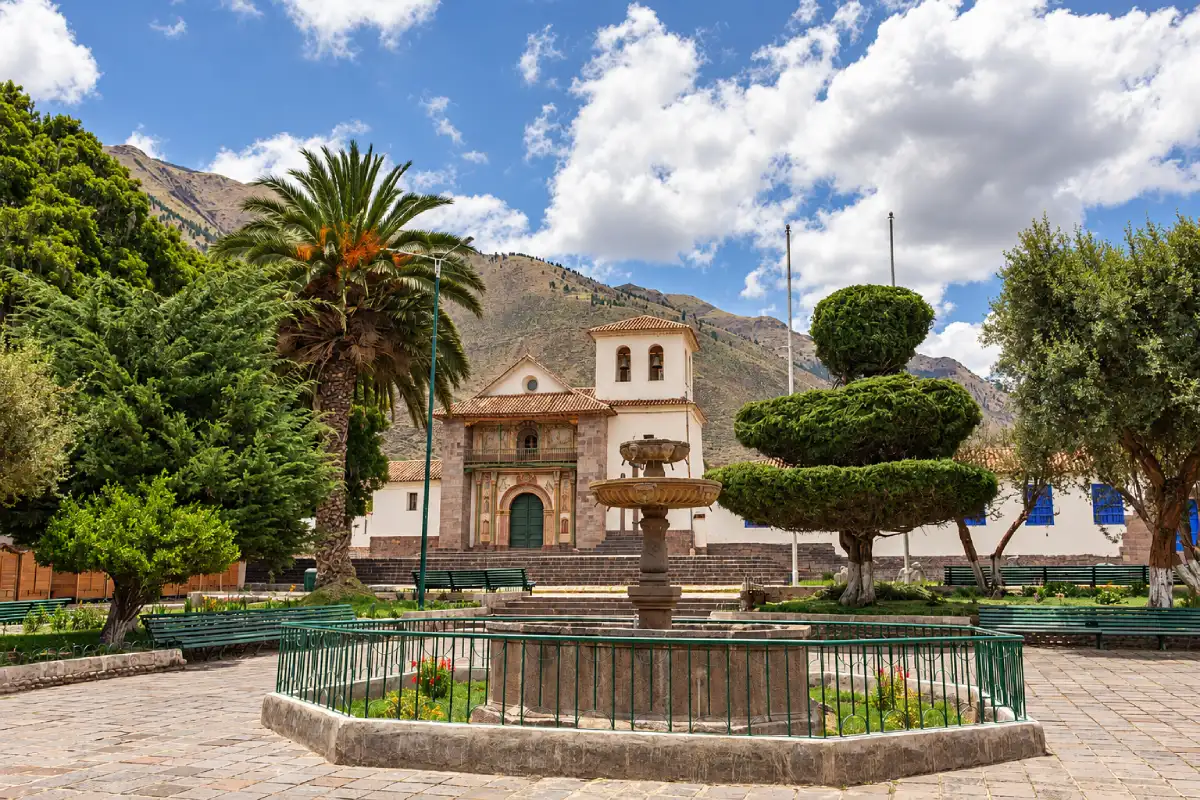
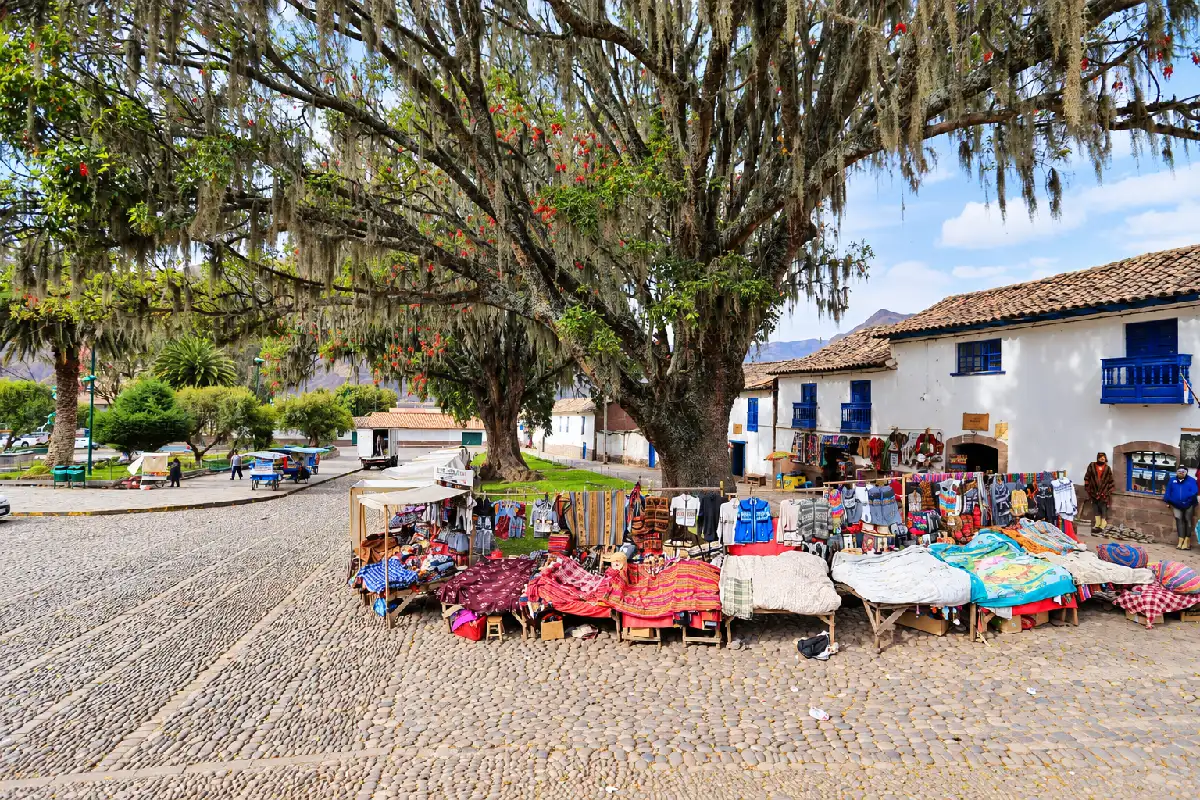
The historic center of Andahuaylillas is arranged around a small main square, where the Church of San Pedro de Andahuaylillas stands as the village’s most important landmark. The square is surrounded by historic houses built with adobe bricks and ashlar stone, many featuring gypsum plaster finishes, traditional wooden balconies, and clay-tiled roofs.
One of its most striking features is the presence of enormous Andean Pisonay trees. They have bright red flowers and hanging Spanish moss give the plaza a timeless character while providing welcome shade.
Take some time to walk through the nearby narrow streets, where cobblestone sections and traditional homes still preserve elements of the village’s colonial architecture.
Experience Local Customs and Daily Life
Life in the Andean village of Andahuaylillas remains closely connected to agriculture, particularly corn farming and traditional forms of communal work. Spending time around the village offers a glimpse into the quieter pace of daily life in Cusco’s South Valley.
Religious celebrations also play an important role in the community, bringing together faith, music, Peruvian food, and traditions that have been passed down through generations.
- Holy Week: March or April, depending on the liturgical calendar.
- Corpus Christi: May or June, depending on the liturgical calendar.
- Feast of San Pedro Apóstol: June 29.
Discover Local Handicrafts
Andahuaylillas village also preserves traditional crafts and cultural expressions such as handwoven textiles, gold and silver metalwork.
Some handicrafts are still produced using techniques passed down through local families and communities. Visitors can find examples of this work in small shops and local spaces where Andean traditions and Catholic beliefs come together through art, symbols, and religious expressions.
Learn About the Andahuaylillas Alien
One of the most curious local stories is the Andahuaylillas alien, linked to unusual mummified remains once displayed at the Museo Ritos Andinos. Their elongated skulls and unusual appearance led to speculation about extraterrestrial origins.
Later studies identified the remains as human and connected their skull shape to ancient Andean cranial modification practices. Today, the story remains an unusual part of Andahuaylillas’s local folklore and archaeological interest.
Tips for Visiting Andahuaylillas
- Bring a light jacket, sunscreen, and rain poncho depending on the season.
- Take some time to explore the main square and nearby streets instead of visiting only the church.
- Follow all rules regarding photography and video recording inside the church.
- Carry some cash for entrance fees, small shops, and local purchases.
- Be respectful during Mass, processions, and other religious celebrations.
- To make the most of your trip, combine Andahuaylillas with Tipón, Pikillacta, and other attractions in the Cusco South Valley.
History of Andahuaylillas
The history of Andahuaylillas dates back to long before the Inca period. Over the centuries, the valley was inhabited by several Andean societies and was later reorganized during colonial times. These different historical periods can still be seen in the town’s landscape, architecture, and traditions.
Andahuaylillas Before the Arrival of the Spanish
The Andahuaylillas Valley was inhabited long before Inca Emperors rule. Archaeological evidence shows the presence of cultures and traditions such as Chanapata, Wari, Qotakalli, and Killke. The availability of water and fertile farmland encouraged communities to settle here during different historical periods.
Later, the area became connected with the cultural environment of Pikillacta and was eventually incorporated into Inca territory. This evidence shows that the history of Andahuaylillas began many centuries before the colonial period.
Andahuaylillas During the Colonial Period
During the 16th century, Andahuaylillas was reorganized as a colonial settlement, with a central square, a more formal street grid, and the church serving as the main religious space. This new urban model transformed the appearance of the town and strengthened its role as a center of evangelization in the province of Quispicanchi.
However, Andean traditions did not disappear completely. Over time, Indigenous and Christian elements began to coexist, and this blending became reflected in the religious, artistic, and cultural expressions that still form part of Andahuaylillas today.
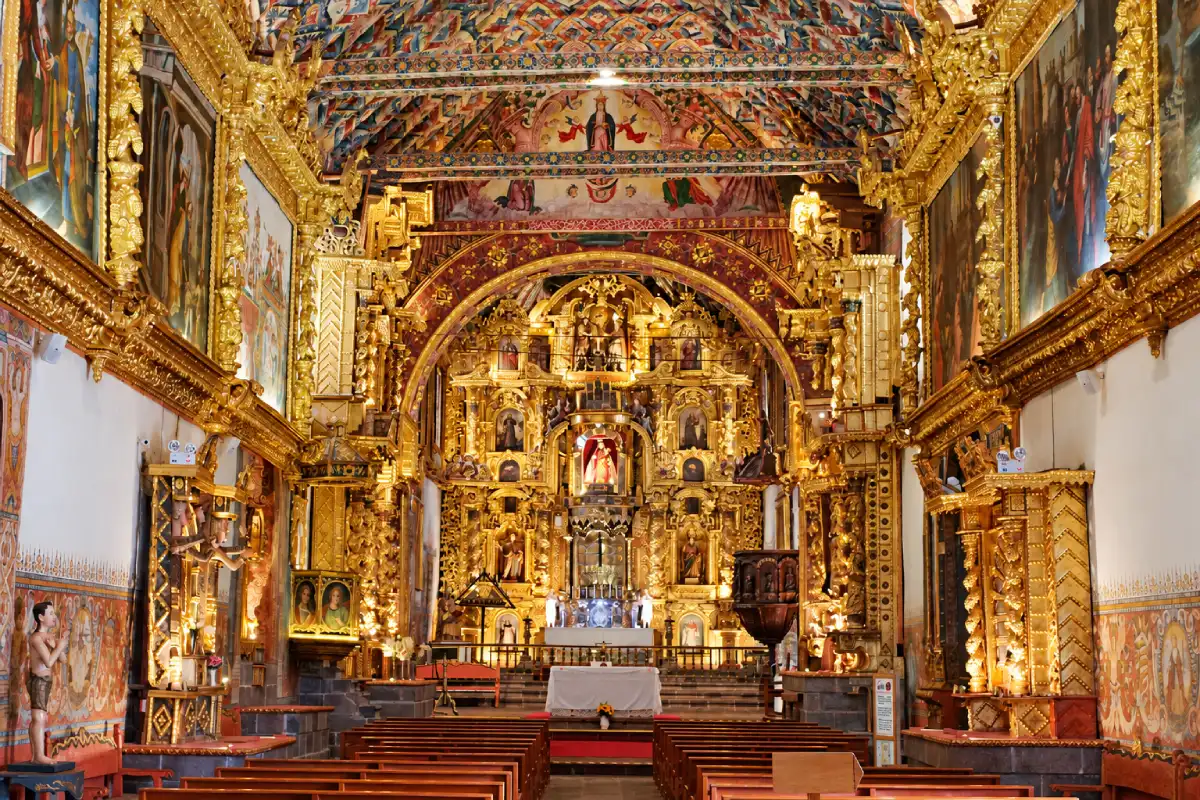
Church of Andahuaylillas: The Sistine Chapel of America
The Church of San Pedro de Andahuaylillas dominates one side of the main square and is the most recognizable monument in Andahuaylillas. Its relatively simple exterior contrasts dramatically with its richly decorated interior, filled with murals, paintings, altarpieces, carved wood, and gilded details.
Together, these elements make the church one of the finest examples of religious art developed in the southern Andes.
History and Construction of the Church
By the end of the 16th century, a small chapel already existed in Andahuaylillas. At the beginning of the 17th century, the church started to take on its current appearance, and around 1610, parish priest Juan Pérez de Bocanegra promoted an important period of construction and decoration.
During the following decades, paintings, altarpieces, organs, and other religious elements were added, turning the church into one of the most remarkable artistic ensembles of Cusco’s colonial period.
Why Is It Known as the Sistine Chapel of the Americas?
The Andahuaylillas church is popularly known as the “Sistine Chapel of America” because of the extraordinary visual richness of its interior. Its walls and ceilings are covered with murals, paintings, gilded altarpieces, an elaborately decorated wooden ceiling, and numerous pieces of religious art.
The nickname does not mean the church is a replica of the Sistine Chapel in the Vatican. Instead, it refers to the abundance, quality, and impressive concentration of artwork preserved inside.
Did you know? Andahuaylillas is not the only Andean church compared with the Sistine Chapel. In Oruro, Bolivia, the Church of Santiago de Curahuara de Carangas is known as the “Sistine Chapel of the Andes” because of its extensive murals. It should not be confused with San Pedro Apóstol in Andahuaylillas, known as the “Sistine Chapel of the Americas.”
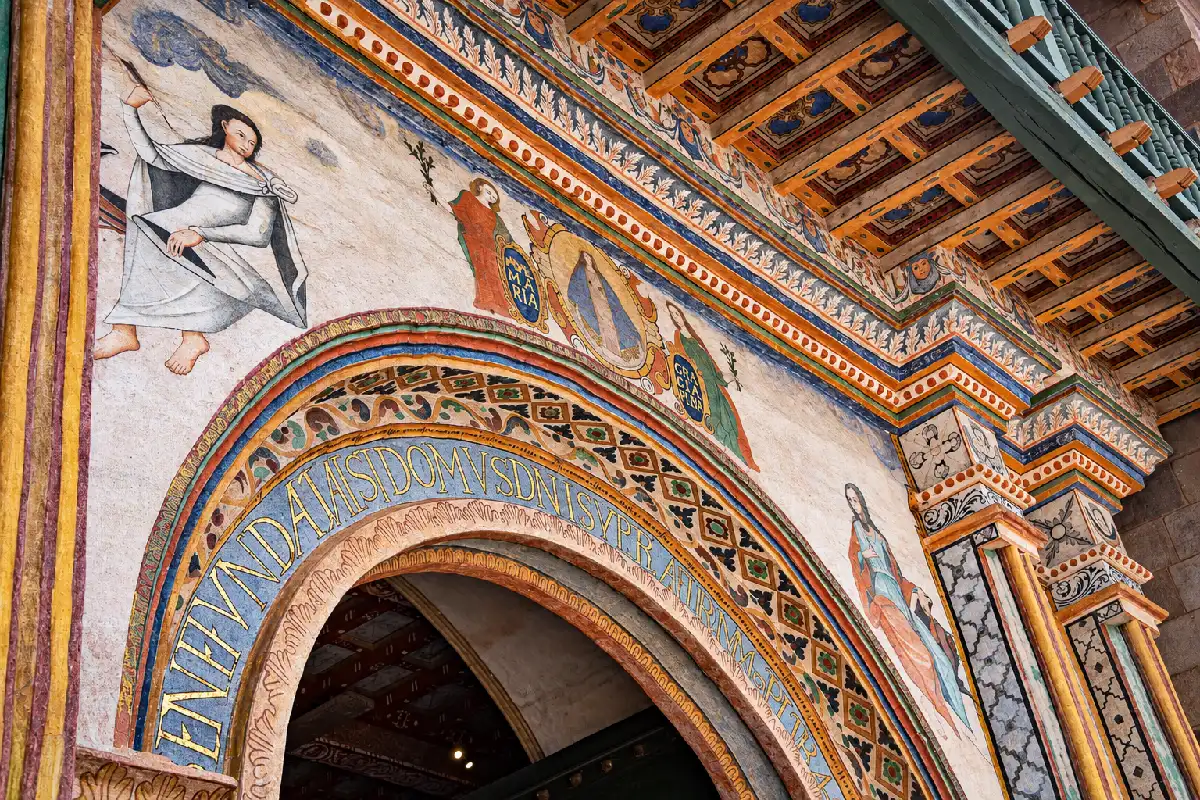
Art and Architecture of Andahuaylillas Church
The interior of the Church of San Pedro Apóstol brings together murals, paintings, altarpieces, carved wood, and other artistic elements created during the 17th and 18th centuries. These works were not only decorative but also served religious and educational purposes.
Architecture of the Church
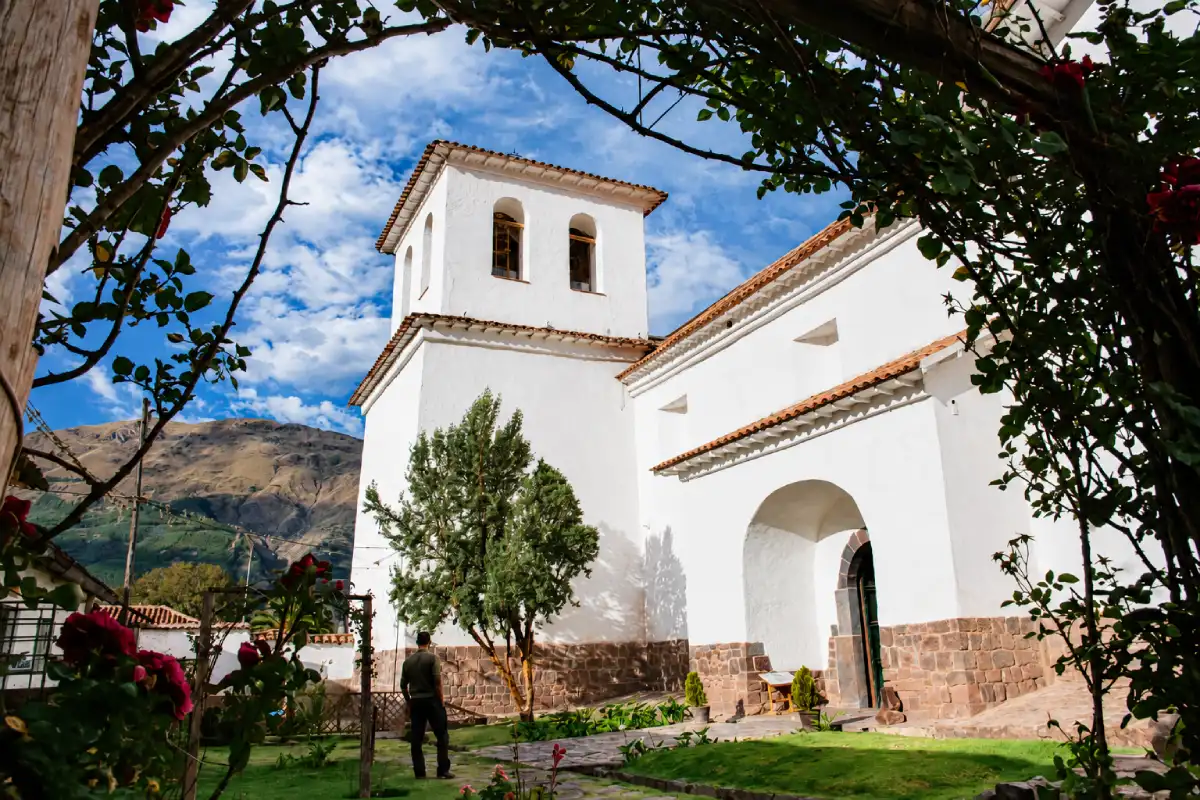
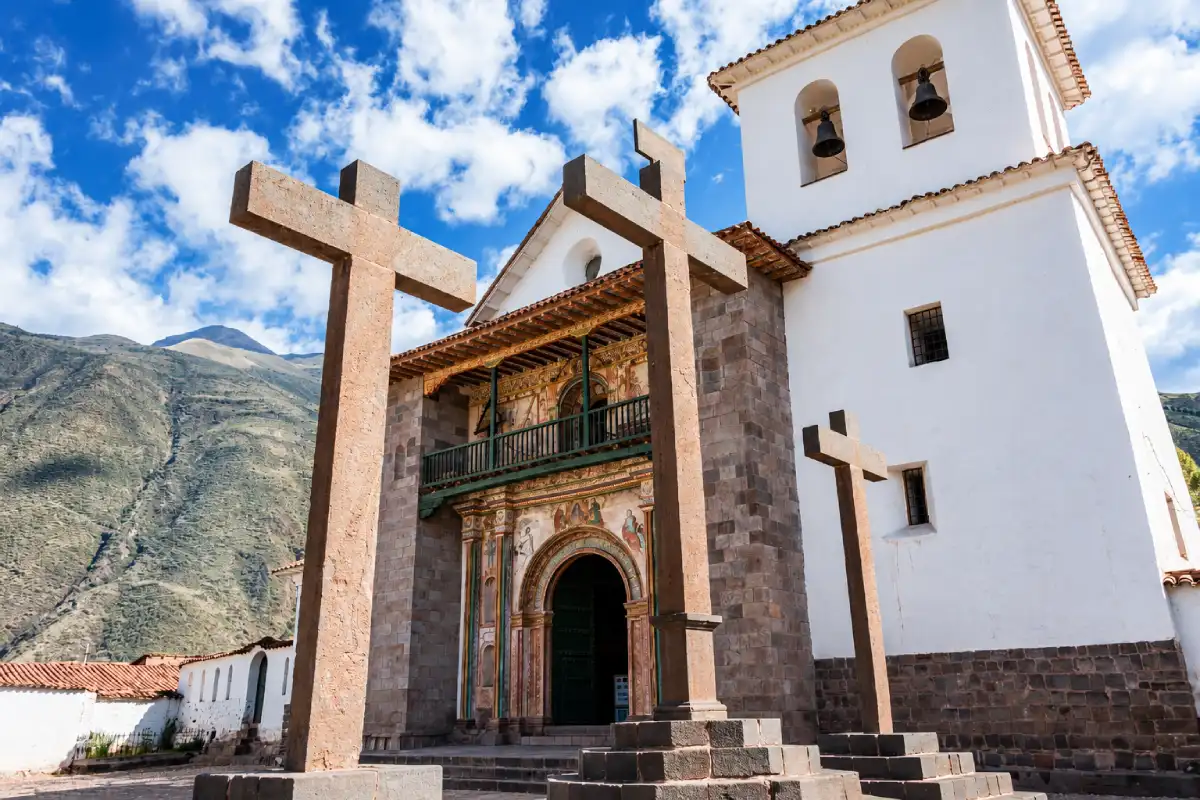
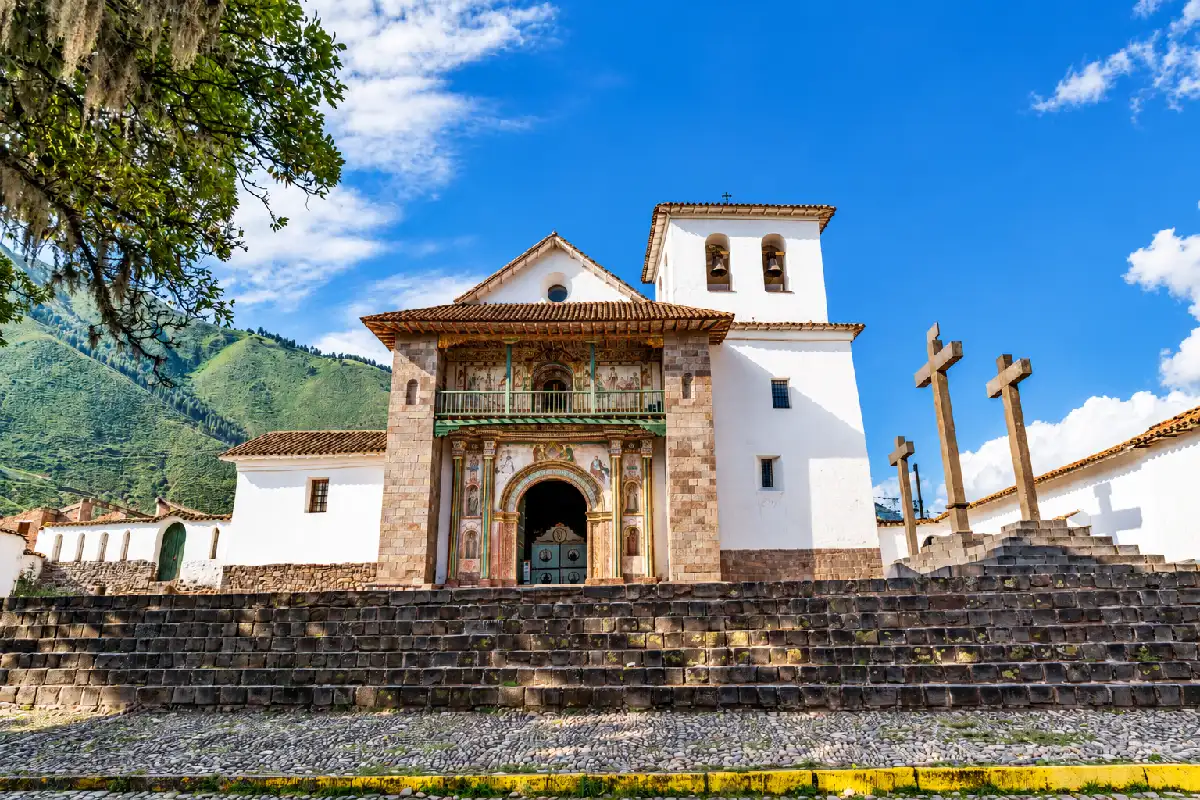
The church has a simple single-nave structure with side chapels, thick adobe walls, and a traditional gabled roof. Outside, visitors can see the atrium, bell tower, and a modest façade featuring wooden elements.
In front of the church stand three stone crosses known as “El Calvario,” which form part of the religious complex surrounding the atrium.
The façade also includes an open chapel designed like a balcony facing the atrium and main square. Religious services were once conducted from this space, allowing clergy to teach Christian doctrine to the Indigenous population gathered outside.
Murals and the Work of Luis de Riaño
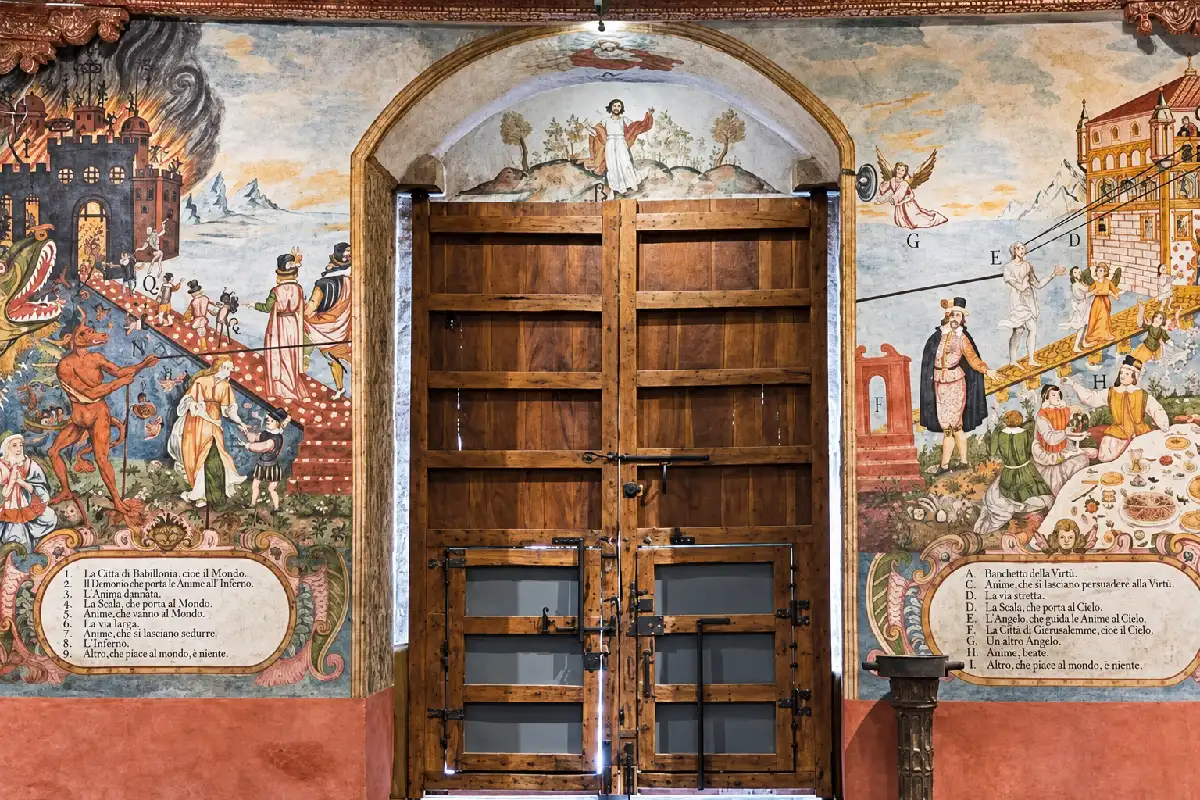
Murals cover important areas of the church with religious scenes and decorative elements. Among the best known are The Road to Heaven and The Road to Hell, created to visually represent the consequences of virtue and sin.
Much of this artistic program is associated with Luis de Riaño, a Lima-born painter and student of Angelino Medoro. The church also preserves signed works by Riaño, including The Baptism of Christ from 1626 and The Archangel Saint Michael from 1628.
Paintings from the Cusco School
The church preserves numerous paintings associated with the Cusco School tradition of the 17th and 18th centuries, including depictions of saints, angels, the Virgin Mary, and different scenes from the life of Saint Peter.
Notable works include Saint Peter Escaping from Prison, the Conversion of Saint Paul, and the Crucifixion of Saint Peter, as well as a depiction of Our Lady of the Rosary attributed to Diego Quispe Tito, one of the most important painters of the Cusco School.
Other Cusco School masterpieces are located in Cusco museums like the Archbishop’s Palace Museum.
Altars and Altarpieces
The church contains a main altarpiece and several side altarpieces made of carved wood and decorated with gilded details. The main altarpiece features images of Saint Peter, Saint Paul, and Our Lady of the Rosary, while its columns, sculptures, and reliefs give much of the interior its distinctive Baroque character.
Among the side altarpieces are those dedicated to Saint Peter, Calvary, Our Lady of Mercy, Our Lady of Mount Carmel, and the Holy Family.
The Wooden Coffered Ceiling
The polychrome wooden coffered ceiling is especially impressive in the presbytery, where it combines geometric patterns, painted details, gilded elements, and symbols associated with Saint Peter.
Its decoration shows a strong Mudéjar influence, visible in the geometric forms and techniques inherited from Hispano-Muslim artistic traditions.
The Historic Organs of Andahuaylillas
Two 17th-century organs are preserved in the choir loft, known as the Organ of the Angels and the Organ of King David and the Queen. Their wooden cases are decorated with paintings of figures and musical angels, and some of this artwork has been associated with Luis de Riaño.
Music played an important role in the religious life of the church. Juan Pérez de Bocanegra was also associated with Hanaq Pachap Kusikuynin, one of the earliest printed polyphonic compositions in the Americas featuring lyrics in Quechua.
Religious Art and Evangelization
The church’s artwork also served an educational purpose during the evangelization period. Murals and religious images helped explain ideas such as baptism, salvation, sin, heaven, and hell to people who spoke different languages and followed different cultural traditions.
One example can still be seen in the baptistery, where a baptismal formula appears written in Latin, Spanish, Quechua, Aymara, and Puquina, reflecting the linguistic diversity of the southern Andes.
Andahuaylillas and the Andean Baroque Route
Andahuaylillas holds an important place along the Andean Baroque Route thanks to the artistic richness of the Church of San Pedro de Andahuaylillas. This cultural route connects several churches in Cusco and the South Valley that preserve outstanding examples of religious art created during the colonial period.
What Is the Andean Baroque Route?
The Andean Baroque Route is a cultural journey connecting four churches where visitors can admire murals, altarpieces, sculptures, and other examples of colonial religious art. Their interiors reveal how European artistic techniques and styles were gradually adapted to the cultural environment of the Andes.
More than simply a route between churches, the journey offers an opportunity to understand different ways religion and art were represented in southern Cusco. Among these churches, San Pedro Apóstol in Andahuaylillas stands out for its murals, altarpieces, paintings, and richly decorated interior.
Which Other Churches Are Part of the Route?
In addition to the Church of San Pedro Apóstol in Andahuaylillas, the route includes the Church of the Society of Jesus in Cusco, the Church of San Juan Bautista in Huaro, and the Chapel of the Virgen Purificada in Canincunca.
Andahuaylillas, Huaro, and Canincunca form the South Valley section of the route and can easily be visited during the same trip.
If you are planning a trip to Cusco, consider adding Andahuaylillas to your South Valley itinerary for a closer look at the region’s history, art, and local culture.
Andahuaylillas FAQs
Is Andahuaylillas part of the Sacred Valley?
No. Andahuaylillas belongs to the province of Quispicanchi and forms part of Cusco’s South Valley, a tourist route that also includes places such as Tipón and Pikillacta.
Can you take photographs inside the Church of Andahuaylillas?
Photography inside the church is restricted to help protect the paintings and other works of art. It is best to follow the instructions given by staff before using cameras or mobile phones inside.
Is Andahuaylillas village suitable for visiting with children?
Yes. The Andean village and church can easily be visited as a family and do not require any demanding walks. Inside the church, children should remain accompanied by an adult and respect conservation rules and the religious nature of the site.
Are Masses still held in the church of Andahuaylillas?
Yes. San Pedro Apóstol continues to operate as an active parish, and Masses and religious celebrations are held throughout the year. Schedules may vary, especially during festivals, when tourist visiting hours can also change.
Do you need to book in advance to visit the Church of Andahuaylillas?
No. Advance booking is not normally required for a regular visit, and tickets can be purchased directly at any of the churches along the Andean Baroque Route. During festivals or religious celebrations, it is a good idea to check the opening hours before traveling, as tourist access may change.
Where to say in Andahuaylillas?
There are only a few places to stay in Andahuaylillas, and most are simple, locally run accommodations with basic services rather than standardized hotel facilities. Travelers looking for a wider range of hotels and amenities may prefer to stay in Cusco and visit Andahuaylillas as part of a day trip through the South Valley.
Where to eat near Andahuaylillas?
There are a few tourist restaurants in Andahuaylillas, but you will find more dining options in Urcos, located just a short drive away. If you want to try traditional local food, Huasao is known for dishes such as baked guinea pig served with noodle pie, while Saylla is especially famous for its traditional pork chicharrón.

Add new comment